 By
By 35 Best Travel Gear Essentials for the Balkans
The Balkans can be surprisingly tricky to pack for. One trip might take you from the cobbled streets of an old town to a mountain trail, a lakeside village, and a sunny Adriatic beach—all within a matter of days.
That variety is part of what makes traveling here so rewarding, but it also means you need to pack with a little flexibility. A lightweight rain jacket might seem unnecessary while you’re enjoying the Croatian coast, then become one of the most useful things in your bag when the weather changes in the mountains of Montenegro or Albania.
The best approach is to bring versatile, lightweight gear that you’ll actually use rather than preparing for every possible situation. Comfortable walking shoes, practical layers, a reliable backpack, a power bank, and a few well-chosen travel accessories can cover most trips without weighing you down.
In this guide to the best travel gear for the Balkans, we’ll cover what to pack for city breaks, road trips, beaches, hiking adventures, and longer multi-country journeys. You’ll also find seasonal packing advice, useful electronics and safety gear, and a few things you can probably leave at home.
Whether you’re spending a week in one country or backpacking across the region, the goal is simple: pack smarter, carry less, and be prepared for the places you actually plan to explore.
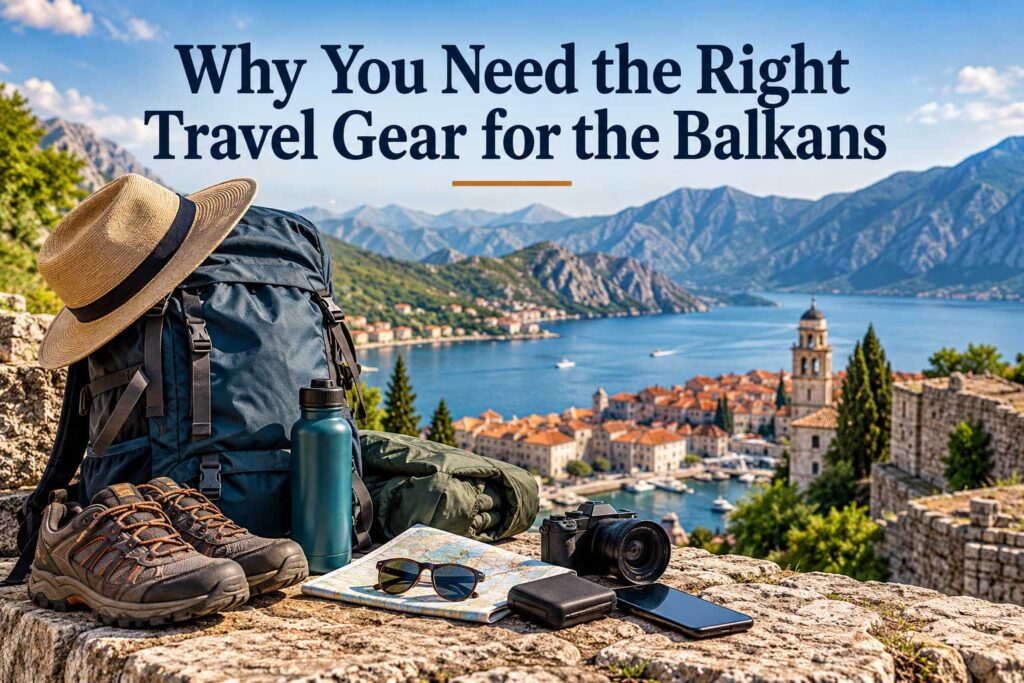
Why You Need the Right Travel Gear for the Balkans
Traveling through the Balkans often involves more variety than you might expect. You can spend the morning walking through a historic city, drive into the mountains in the afternoon, and end the day somewhere along the coast. If you’re visiting several countries, you’ll probably also be moving between hotels, buses, ferries, rental cars, and different types of terrain.
That’s why the best Balkan travel gear isn’t necessarily the most expensive gear. It’s the equipment that can handle several situations without taking up half your luggage.
Prepare for Different Terrain
Cobblestone streets are common in historic centers, while the Balkan Mountains and national parks can quickly take you onto rocky or uneven trails. Comfortable shoes and a lightweight daypack will usually prove more useful than packing specialized equipment for every activity.
If hiking is a major part of your itinerary, you can add proper hiking footwear and outdoor gear based on the trails you plan to tackle.
Expect Changing Weather
Conditions can vary considerably between the coast, inland cities, and higher elevations. A hot afternoon beside the Adriatic doesn’t necessarily tell you what the weather will be like later in the mountains.
Rather than packing bulky clothing for every possibility, bring layers you can combine as needed. A lightweight waterproof jacket is particularly useful because it takes up little room and works for both rain and windy conditions.
Plan for Plenty of Walking
The Balkans reward travelers who explore on foot. Old towns such as Dubrovnik and Kotor have narrow streets and plenty of steps, while destinations throughout Bulgaria, Romania, Albania, and Bosnia and Herzegovina can involve long days of sightseeing.
Comfortable walking shoes, a refillable water bottle, sun protection, and a small backpack can make a much bigger difference than bringing dozens of travel accessories.
Keep Your Setup Simple
You don’t need a gadget for every possible travel problem. Packing cubes can keep clothing organized, a small electronics pouch prevents cables from disappearing into your bag, and a power bank keeps your phone running during long days away from your accommodation.
The goal is to pack for the trip you’re actually taking. A beach-focused vacation in Croatia requires a different setup from a hiking trip through Albania and Montenegro. Choose versatile essentials first, then add specialized gear only when your itinerary genuinely calls for it.
Affiliate Disclosure: This post may contain affiliate links. If you purchase a product or service through one of these links, we may earn a commission at no additional cost to you.
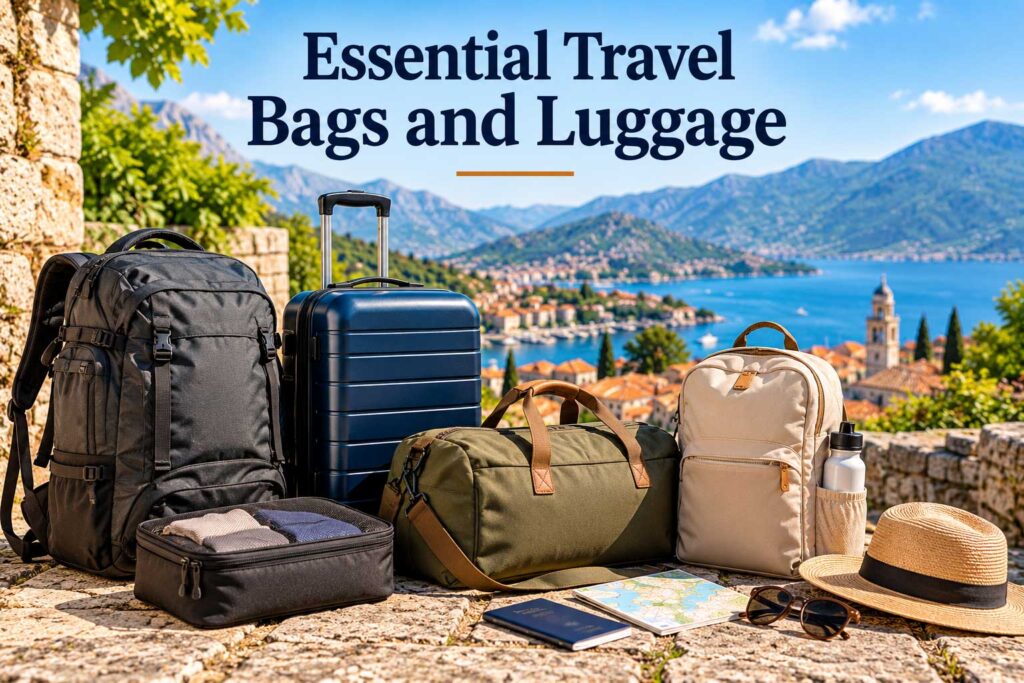
Essential Travel Bags and Luggage
Your choice of luggage can make a noticeable difference when traveling through the Balkans. Historic centers often have cobblestones, stairs, and pedestrian-only streets, while ferries, buses, and frequent hotel changes can make a heavy suitcase frustrating to manage.
There’s no single bag that works for everyone. For a multi-country trip, a carry-on backpack paired with a smaller daypack is often a practical setup. If you’re staying mainly in one destination or traveling by rental car, a wheeled suitcase may work perfectly well.
Carry-On Travel Backpack
A travel backpack for Europe is especially convenient when you’ll be changing destinations frequently. You can carry it over cobblestones, up apartment stairs, onto buses, and through train stations without worrying about wheels getting stuck.
For many travelers, a backpack somewhere around the 35–45 liter range offers a useful balance between capacity and portability. The right size depends on how much you pack and, if you’re flying with carry-on luggage only, the size and weight limits imposed by your airline.
If you’re hoping to travel with carry-on luggage only, check your airline’s current size and weight restrictions before buying a bag. European airline allowances vary, and simply being described as a “carry-on backpack” doesn’t guarantee that a bag will qualify.
Hiking Daypack
You probably won’t want to carry your main travel bag while sightseeing or heading out for a day hike. A lightweight daypack gives you enough room for water, snacks, sunscreen, a camera, power bank, and an extra layer without becoming cumbersome.
For city sightseeing, a simple pack may be all you need. If you’re planning longer hikes, especially around some of the high peaks of the Balkans, look for padded straps, a breathable back panel, water bottle pockets, and enough room for basic hiking essentials.
A packable daypack can be particularly useful when luggage space is limited because it folds down when you’re not using it.
Packing Cubes
Packing cubes for travel aren’t essential, but they’re one of those accessories that become surprisingly useful on a multi-stop trip.
Instead of unpacking your entire bag every time you arrive somewhere new, you can keep shirts in one cube, underwear and socks in another, and swimwear or miscellaneous clothing somewhere else. A separate cube or lightweight laundry bag also prevents worn clothing from getting mixed with clean items.
Compression cubes can save some space, although they won’t reduce the actual weight of your luggage.
Waterproof Dry Bag
A dry bag makes more sense for some Balkan itineraries than others. If you’re kayaking, rafting, boating, visiting beaches, or spending considerable time around lakes and rivers, it’s an inexpensive way to protect your phone, wallet, camera, and spare clothing.
You may find one particularly useful around destinations such as Lake Ohrid, the Adriatic coast, or on rafting trips in Bosnia and Herzegovina and Montenegro.
For a city-focused itinerary, however, you probably don’t need one. A small waterproof pouch for your phone and documents may be enough.
Anti-Theft Backpack or Secure Daypack
You don’t necessarily need to buy a separate “anti-theft” backpack. If your regular daypack has secure zippers and internal compartments, it may already do the job.
Features such as lockable zippers, concealed pockets, and an internal passport compartment can be useful in crowded transportation hubs and busy tourist areas. More important than specialized features is keeping valuables somewhere difficult to access and avoiding leaving your passport, wallet, or phone in an open outer pocket.
If you’re carrying expensive camera equipment or a laptop, a bag with padded internal compartments can provide additional protection while you’re moving between destinations.
Quick Comparison
| Travel Bag or Accessory | Best For | Do You Need It? |
|---|---|---|
| Carry-on backpack | Multi-country and frequent-stop trips | Highly useful |
| Hiking daypack | Sightseeing and day hikes | Highly useful |
| Packing cubes | Keeping luggage organized | Recommended |
| Waterproof dry bag | Beaches, kayaking and rafting | Itinerary dependent |
| Secure/anti-theft backpack | Cities and public transportation | Optional |
For most travelers, there’s no reason to build an elaborate luggage system. One comfortable main bag, a lightweight daypack, and a few packing cubes will cover the majority of Balkan trips.
Choose additional gear based on what you’ll actually be doing. Someone island-hopping along the Adriatic has different needs from someone hiking through Albania, Montenegro, and Bulgaria—and your luggage should reflect that.
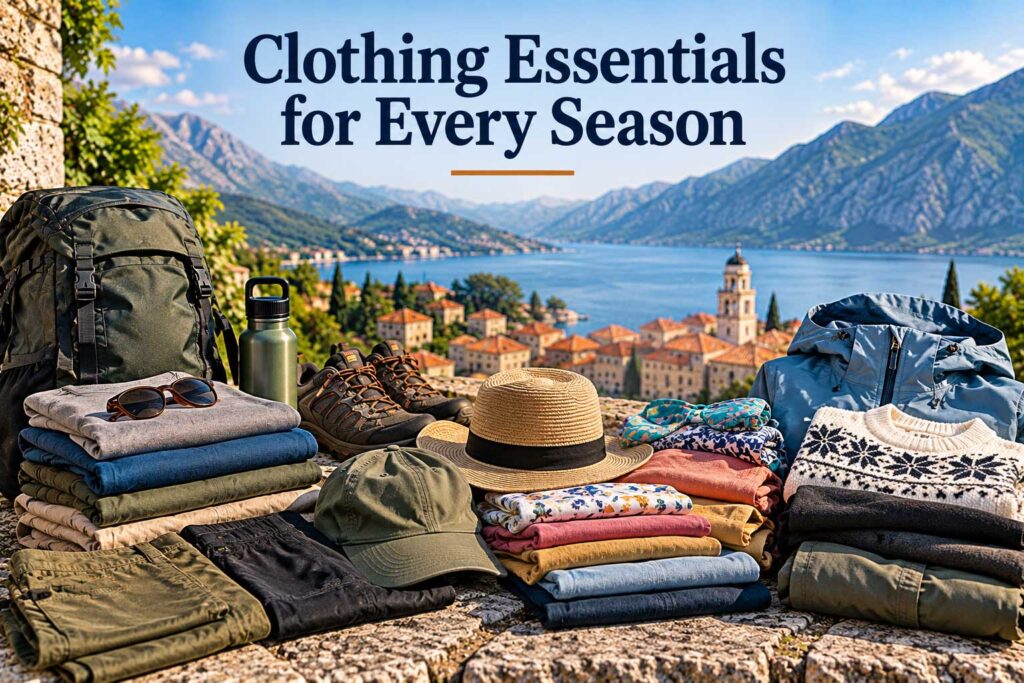
Clothing Essentials for Every Season
There’s no single Balkan packing list that works year-round. A July trip along the Croatian or Montenegrin coast can mean hot days and plenty of sun, while a mountain itinerary in Albania, Bulgaria, Romania, or Bosnia and Herzegovina may require an extra layer even during warmer months.
Instead of packing for every possible condition, build your travel wardrobe around layers that work together. You’ll carry less and have more flexibility when the weather changes.
Breathable, Quick-Drying Shirts
For warm-weather trips, pack shirts that are comfortable enough to wear through a full day of sightseeing. Lightweight synthetic blends and merino wool are popular travel options because they dry relatively quickly after washing.
Cotton can still be perfectly comfortable for casual sightseeing, particularly in hot cities and coastal destinations. The drawback is that it generally takes longer to dry, so it may be less convenient if you’re washing clothes during a multi-stop trip.
For most trips, a handful of shirts that can be mixed and matched is more useful than packing a different outfit for every day.
For warmer city and coastal trips, you can also build part of your wardrobe around a few lightweight summer travel dresses that work for sightseeing, restaurants, and evenings out.
Lightweight Travel or Hiking Pants
Jeans are fine for city trips, but they can feel heavy during hot weather and take a long time to dry. Lightweight travel pants are often more practical when your itinerary combines sightseeing with outdoor activities.
Look for a comfortable fit and enough stretch for long walking days. Secure pockets are useful when you’re carrying a phone or wallet, while quick-drying fabric makes washing clothes during the trip easier.
If you’re primarily visiting beaches and cities in summer, you may not need technical hiking pants at all. Pack them when the activities on your itinerary justify them.
Lightweight Waterproof Jacket
A packable rain jacket is one of the few clothing items I’d consider for almost any Balkan itinerary.
Summer weather can be beautiful along the coast, but conditions are less predictable once you head inland or into the mountains. A lightweight shell gives you protection from both rain and wind without taking up much room in your luggage.
You don’t need a heavy waterproof jacket for a typical summer vacation. Save insulated outerwear for colder seasons and use a thin shell that can be layered over other clothing.
Fleece or Lightweight Mid Layer
A fleece, sweater, or lightweight insulated layer is useful for cool mornings, mountain destinations, air-conditioned transportation, and shoulder-season trips.
The important thing is that it works underneath your rain jacket. This gives you a simple layering system: wear the mid layer when it’s cool, the waterproof shell when it’s wet or windy, and both when conditions require extra protection.
For a summer beach-focused itinerary, one light sweater or fleece may be plenty.
Comfortable Walking Shoes
If there’s one piece of clothing worth getting right, it’s your footwear.
Historic centers throughout the Balkans can involve cobblestones, steep streets, stairs, and long days on foot. Choose shoes you’ve already worn comfortably for several hours rather than buying a new pair immediately before departure.
Good grip is particularly helpful on polished stone and wet cobblestones. More importantly, choose shoes that fit your feet properly. The most expensive travel shoe isn’t useful if you’re uncomfortable after an hour of walking.
Hiking Shoes or Boots
You don’t automatically need hiking boots simply because you’re visiting the Balkans.
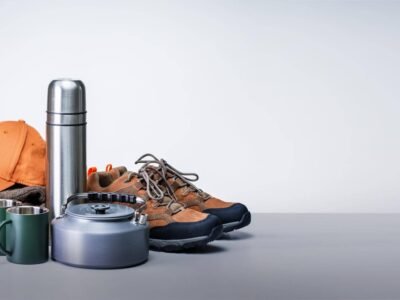
If you’re sticking to cities, beaches, viewpoints, and easy trails, comfortable walking shoes or trail shoes may be enough. Proper hiking footwear becomes more important when your itinerary includes longer or rougher trails in places such as the Albanian Alps, Durmitor National Park, Rila Mountains, or Carpathians.
Choose your footwear according to the difficulty and conditions of the trails rather than the destination alone.
Sandals or Water-Friendly Shoes
Sandals earn their place in your luggage during warmer months, particularly if you’re spending time along the Adriatic or Aegean coast.
Comfortable walking sandals can double as casual evening footwear, while water shoes may be useful on some rocky or pebbly beaches. You probably don’t need both unless your itinerary includes plenty of time around the water.
Clothing Checklist
| Clothing | Best For | Priority |
|---|---|---|
| Breathable shirts | Everyday sightseeing | Essential |
| Lightweight travel pants | Walking and outdoor activities | Recommended |
| Waterproof jacket | Rain, wind and changing weather | Highly useful |
| Fleece or mid layer | Mountains and cooler evenings | Recommended |
| Comfortable walking shoes | Cities and everyday exploring | Essential |
| Hiking shoes or boots | Longer and rougher trails | Itinerary dependent |
| Sandals | Beaches and summer trips | Seasonal |
The easiest way to avoid overpacking is to stop thinking in terms of individual outfits and start thinking in layers and combinations. A small collection of clothes that work together can take you from a city sightseeing day to a cool mountain evening without requiring an oversized suitcase.
Before packing specialized clothing, look at your actual itinerary. If you’re spending ten days exploring cities and beaches, you don’t need to pack as though you’re heading on a week-long trek through the mountains.
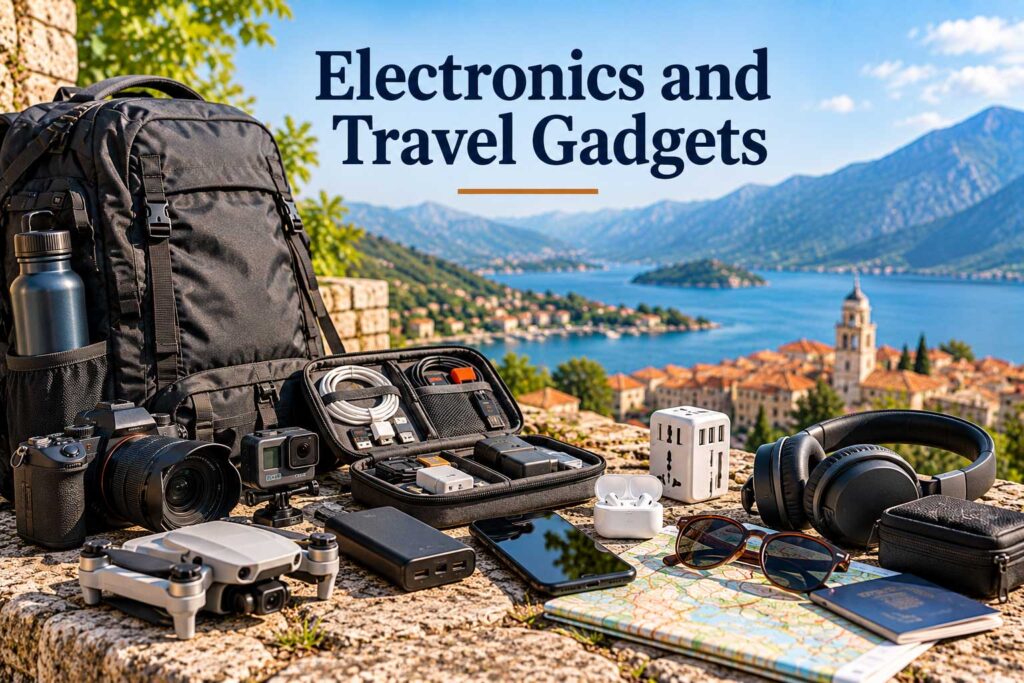
Electronics and Travel Gadgets
You don’t need a bag full of electronics to travel around the Balkans. For most trips, your phone will handle navigation, tickets, translations, bookings, photos, and communication. A few carefully chosen accessories can keep it—and any other devices you’re carrying—working throughout the day.
The most useful travel electronics are usually the boring ones: a reliable charger, the correct plug adapter, a power bank, and a way to get online.
Travel Adapter
If you’re traveling from the United States, Canada, the UK, or another country that uses different plugs, you’ll need an appropriate plug adapter.
Type C and Type F sockets are common across much of the Balkans, but plug types can vary by country and accommodation. If your itinerary includes several countries, a compact universal adapter can be easier than carrying individual adapters.
One important distinction: a plug adapter does not convert voltage. Much of Europe uses roughly 230V electricity, so check the voltage information printed on your device or charger before plugging it in. Many modern phone and laptop chargers accept 100–240V, but you shouldn’t assume every electrical device does.
For travelers carrying several devices, an adapter with built-in USB-C and USB-A ports can also reduce the number of separate chargers you need.
Power Bank
A power bank is one of the most useful gadgets for long sightseeing days.
Navigation, photography, translation apps, mobile tickets, and constant searching can drain a phone much faster than normal. That’s particularly inconvenient when your phone also contains your hotel address, boarding pass, or bus reservation.
A 10,000 mAh power bank is a practical size for many travelers because it provides useful extra power without adding too much weight. Larger capacities can make sense for hiking or long travel days away from outlets.
Remember that airlines generally require spare lithium batteries and power banks to travel in carry-on baggage rather than checked luggage, and capacity restrictions may apply. Check your airline’s current rules before flying.
Multi-Port USB-C Wall Charger
If you’re carrying a phone, watch, camera, tablet, or laptop, you can quickly end up with a pile of charging bricks.
A compact multi-port wall charger can simplify the setup considerably. One charger with several USB-C or USB-A ports may be able to charge multiple devices from a single outlet—particularly useful in older accommodations where conveniently placed sockets can be limited.
Check the charger’s total power output if you intend to charge a laptop, as smaller phone chargers may not provide enough power.
Noise-Canceling Headphones or Earbuds
Noise-canceling headphones aren’t essential, but they can earn their luggage space if your trip includes a long international flight or several bus and train journeys.
Over-ear headphones generally provide better isolation and comfort on long journeys, while wireless earbuds take up considerably less room. Which makes more sense comes down to how you travel.
If you’re trying to pack light, use the pair you already own rather than buying something specifically for the trip.
Travel Camera
For many travelers, a modern smartphone is all the camera they need.
A dedicated camera becomes more worthwhile if photography is an important part of your trip, particularly for landscapes, wildlife, low-light scenes, or situations where you want more control over lenses and settings.
If you do bring one, consider the entire setup—not just the camera body. Lenses, batteries, chargers, memory cards, and a protective bag can add substantial weight.
We’ll cover photography equipment in more detail later in this guide.
Action Camera
An action camera is much easier to justify when your itinerary actually includes activities where a phone or conventional camera would be inconvenient.
It can be useful for kayaking, rafting, cycling, skiing, snorkeling, and other activities where a small, rugged camera makes sense. For ordinary city sightseeing, however, it’s probably another gadget you can leave at home.
If you bring one, remember the accessories you’ll actually need, such as spare batteries, a waterproof housing if required, or a secure mount.
eSIM or Local SIM Card
Mobile data is extremely useful when traveling independently through the Balkans. You’ll likely use it for maps, accommodation details, restaurant searches, transportation information, translation, and messaging.
Your best option depends on the countries you’re visiting and your existing mobile plan. Depending on your phone, you might use an eSIM, local prepaid SIM, regional plan, or international roaming package.
Don’t assume that one country’s mobile plan will automatically provide the same roaming terms everywhere on a multi-country Balkan trip. Check exactly which countries are included before purchasing a plan.
Electronics Checklist
| Device | Best For | Priority |
|---|---|---|
| Travel adapter | Travelers using different plug types | Essential when needed |
| Power bank | Long sightseeing and travel days | Highly useful |
| Multi-port USB-C charger | Travelers with several devices | Recommended |
| Noise-canceling headphones | Flights, buses and trains | Optional |
| Travel camera | Serious photography | Itinerary dependent |
| Action camera | Water and adventure activities | Optional |
| eSIM or local SIM | Navigation and staying connected | Highly useful |
Keep your electronics setup simple. For many travelers, a phone, power bank, charger, plug adapter, and reliable mobile data connection are all that’s necessary.
Add cameras, headphones, and other gadgets when they’ll genuinely improve your trip rather than packing them simply because they appear on a typical travel gear checklist. If you want more options, see our guide to the best travel gadgets.
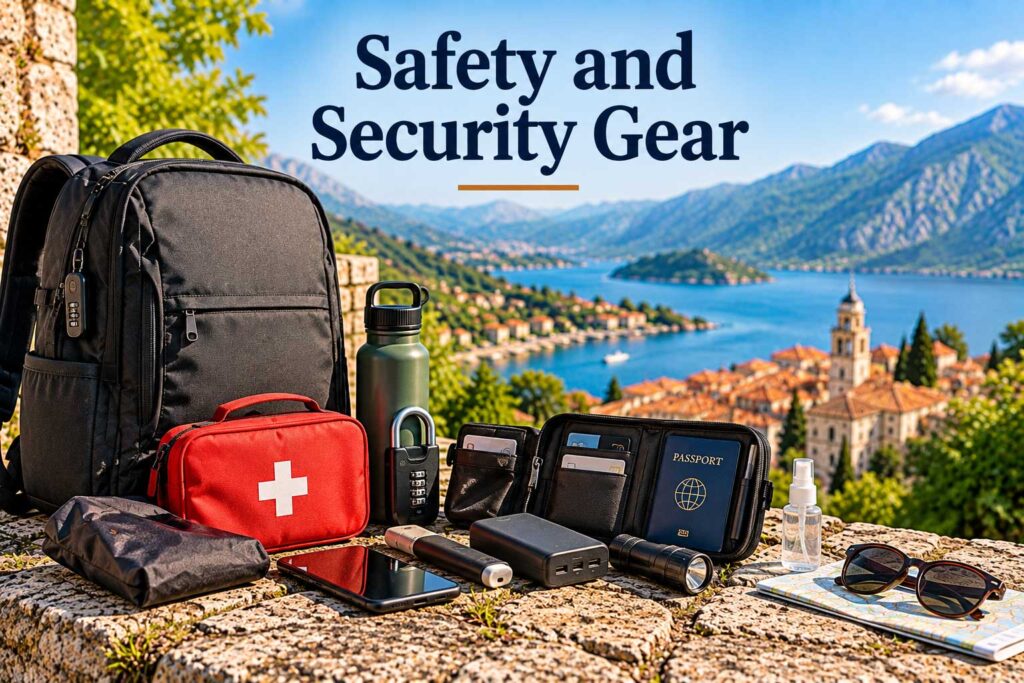
Safety and Security Gear
You don’t need to travel through the Balkans with a bag full of security gadgets. The same precautions that make sense elsewhere in Europe apply here: keep an eye on your belongings in crowded places, don’t leave valuables visible in a rental car, and keep a backup payment method somewhere separate from your main wallet.
A few simple pieces of travel safety gear can still be useful, particularly on multi-country trips or when you’ll be hiking away from major towns.
Passport Wallet or Travel Organizer
A passport wallet is useful primarily because it keeps important documents organized in one place. Depending on your trip, that might include your passport, boarding passes, insurance information, spare cards, and some cash.
You’ll see plenty of travel wallets advertised with RFID-blocking material. That feature is fine to have, but I wouldn’t choose a wallet based on RFID protection alone. A secure zipper, sensible organization, and a design that’s comfortable to carry are more useful day to day.
Be careful about keeping absolutely everything valuable in the same wallet. Losing one organizer containing your passport, cash, and every payment card creates a much bigger problem than losing just one item.
Small Luggage Lock
A small combination lock can be useful for hostel lockers, luggage storage, or securing the zippers on a suitcase or backpack.
If you’re flying to or within the United States, a TSA-compatible lock allows U.S. security officers to open certain locks with approved tools when inspection is required. You don’t specifically need a TSA-branded lock simply because you’re traveling in the Balkans.
And remember that a luggage lock is mainly a deterrent. It can discourage someone from casually opening your bag, but it won’t make luggage theft-proof.
Money Belt or Hidden Pouch
A money belt can be useful if you prefer keeping your passport, emergency cash, or backup card underneath your clothing, particularly during long transportation days or when moving through busy stations.
You don’t necessarily need one for everyday sightseeing. A secure internal pocket or crossbody bag may be more convenient.
Whichever method you choose, don’t keep every payment method in the same place. Carry your everyday wallet normally and store a backup card and emergency cash separately.
Personal Safety Alarm
A personal safety alarm is optional rather than an essential piece of Balkan travel gear.
Some solo travelers like carrying one because it’s small and easy to attach to a bag or keychain. When activated, these devices are designed to produce a loud sound that can attract attention.
If carrying one makes you more comfortable, they’re inexpensive and take up almost no luggage space. There’s no reason every traveler needs to buy one, though.
Compact First Aid Kit
A small first aid kit becomes much more useful once you leave the cities and start hiking, cycling, camping, or exploring more remote areas.
For an ordinary sightseeing trip, you don’t need a miniature hospital in your backpack. A few adhesive bandages, blister treatment, antiseptic wipes, gauze, and any personal medications may be enough.
For longer or more remote hikes, your kit should reflect the route, duration, weather, and distance from help. Don’t rely on a generic travel kit as a substitute for proper preparation.
Keep essential prescription medications in your carry-on rather than checked luggage, and bring enough for the trip plus a reasonable buffer for unexpected delays.
Travel Insurance Information
Travel insurance isn’t technically gear, but your policy information should be easy to access if you need it.
Save the policy number, emergency assistance number, and relevant coverage information somewhere you can reach without relying on a single device. Keeping a digital copy on your phone and a backup stored securely online is usually sufficient; some travelers also prefer a printed copy.
Make sure you understand what your policy actually covers, particularly if your itinerary includes hiking, skiing, rafting, rental cars, or other activities that may have specific conditions or exclusions.
Safety Essentials Checklist
| Item | Main Purpose | Priority |
|---|---|---|
| Passport/travel organizer | Documents and organization | Recommended |
| Small luggage lock | Lockers and luggage | Useful |
| Money belt/hidden pouch | Backup valuables | Optional |
| Personal safety alarm | Attracting attention | Optional |
| Compact first aid kit | Minor injuries and blisters | Recommended |
| Travel insurance information | Access to policy details | Important |
You don’t need to turn your luggage into a portable security system. A secure bag, sensible handling of valuables, a separate backup card, basic first aid supplies, and accessible insurance information will cover the needs of most travelers.
Spend money on specialized security accessories only when they solve a problem you’re actually likely to encounter on your trip.
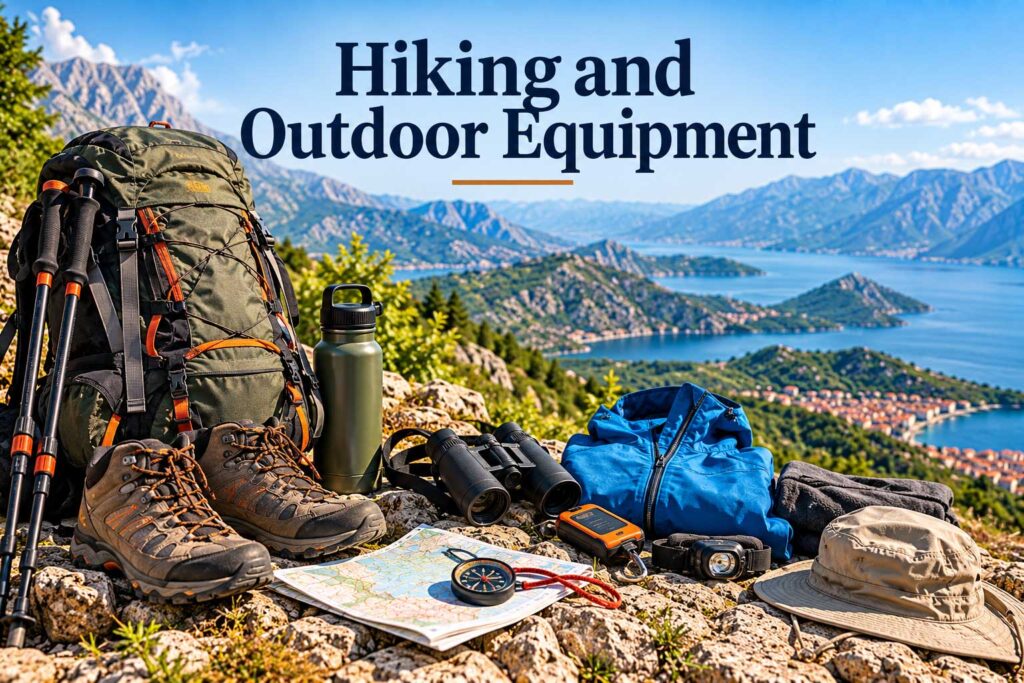
Hiking and Outdoor Equipment
You don’t have to be a serious trekker to spend a lot of time outdoors in the Balkans. Slovenia’s alpine landscapes, the Albanian Alps, Bulgaria’s Rila and Pirin Mountains, Montenegro’s national parks, and the wider Dinaric Alps all offer opportunities ranging from short walks to demanding multi-day routes.
What belongs in your backpack depends heavily on what you’re actually planning to do. Someone taking a few easy walks between city stops needs very different hiking gear from someone heading into the mountains for several days. If hiking is a major part of your trip, our guide to traveling in the Balkan Mountains can give you more ideas for where to explore.
Trekking Poles
Trekking poles can be useful on steep, rocky, muddy, or uneven trails, particularly on long descents. They provide additional points of contact with the ground and can help with balance when the terrain becomes awkward.
Collapsible poles are the most practical option for travel because they’re easier to store when you’re not hiking. Aluminum models tend to be affordable and durable, while carbon-fiber poles can reduce weight but usually cost more.
For short, easy trails, leave them behind. They’re worth considering when mountain hiking is a significant part of your itinerary rather than something you might do once.
Headlamp
A headlamp takes up very little space and is one of the more practical additions to a hiking kit.
It’s useful for early starts, late finishes, camping, and situations where a hike takes longer than expected. Unlike a phone flashlight, it keeps both hands free while you’re moving over uneven terrain.
A rechargeable model can be convenient for travel, but make sure you know how long the battery lasts. For more serious hikes, don’t begin a route that depends on artificial light without checking that your headlamp is charged and working.
Reusable Water Bottle
A reusable bottle is useful whether you’re hiking in the mountains or spending the day sightseeing.
A bottle around 750 ml to 1 liter works well for many everyday situations, but don’t treat that as a fixed recommendation for hiking. How much water you need to carry depends on the weather, trail length, difficulty, available refill points, and your individual needs.
Tap-water quality and access to reliable drinking water vary across the region and sometimes within individual destinations. Check local guidance rather than assuming that every fountain, spring, or tap is suitable for drinking.
Water Filter or Purification System
Most city-focused travelers won’t need a water filter at all.
It becomes more relevant for backcountry hiking, camping, or routes where reliable drinking water may not be available. If you’re considering one, understand what the product actually treats. Different filters and purification systems protect against different contaminants, and not every portable filter removes viruses, chemicals, or all other potential hazards.
Don’t assume that clear mountain water is automatically safe to drink. Research water availability along your specific route and choose an appropriate treatment method when necessary.
Microfiber Travel Towel
A quick-drying towel is particularly handy on trips that combine outdoor activities with beaches, swimming, hostels, or camping.
Microfiber towels pack considerably smaller than standard bath towels and usually dry quickly enough to reuse during a multi-stop trip. The trade-off is that some people simply don’t like how microfiber feels, so this is another item that’s useful rather than essential.
If every accommodation on your itinerary provides towels and you’re not planning to swim outdoors, you can probably leave it at home.
Sun Protection
Sun exposure is easy to underestimate when you’re walking all day, particularly during summer or at higher elevations.
For outdoor days, bring broad-spectrum sunscreen, sunglasses with UV protection, and a hat. Lightweight clothing that covers more skin can also be useful on exposed trails.
How much protection you need depends on the UV level, weather, altitude, duration of exposure, and your skin. Check the day’s conditions rather than assuming cloud cover means you can skip sun protection.
Outdoor Essentials Comparison
| Gear | Best For | Priority |
|---|---|---|
| Trekking poles | Steep and uneven mountain trails | Itinerary dependent |
| Headlamp | Hiking, early starts and late finishes | Recommended for hikers |
| Reusable water bottle | Sightseeing and outdoor activities | Highly useful |
| Water treatment system | Backcountry and remote routes | Itinerary dependent |
| Quick-drying towel | Beaches, swimming and camping | Optional |
| Sun protection | Extended time outdoors | Important |
The most important rule is not to confuse buying outdoor gear with being prepared for the outdoors. Check the route, weather, elevation, water availability, daylight hours, and trail conditions before setting out, particularly in mountainous areas.
For casual sightseeing and short walks, you may need little more than comfortable footwear, water, sun protection, and an extra layer. Add specialized equipment when the route actually requires it.
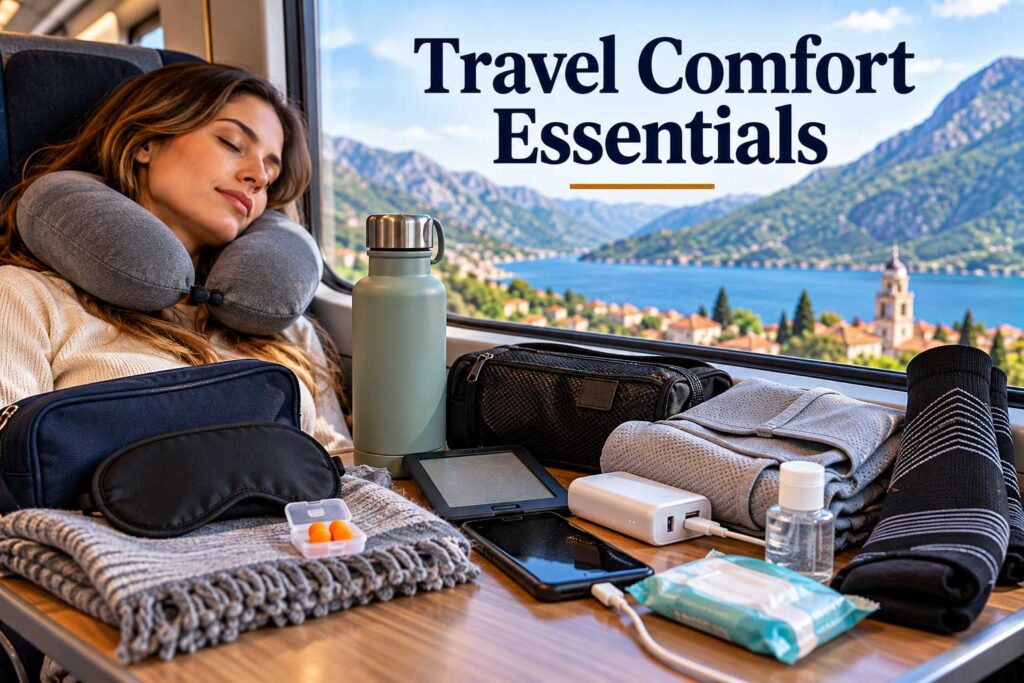
Travel Comfort Essentials
Long travel days are almost inevitable on some Balkan itineraries. Buses are an important way to move between many destinations, ferries connect coastal towns and islands, and travelers arriving from North America may already have spent hours on a plane before the trip really begins.
You don’t need many accessories to make those journeys more comfortable. A few small items can help, but this is also an easy category to overpack.
Travel Neck Pillow
A neck pillow can be worthwhile if you regularly sleep on planes or long-distance buses. If you’ve never found travel pillows comfortable, there’s little reason to carry a bulky one around Europe for two weeks.
Memory-foam pillows tend to provide more structure but take up more luggage space. Inflatable models pack much smaller and can make more sense when you’re traveling with carry-on luggage only.
Whichever style you prefer, consider how small it becomes when you’re not using it. That’s how you’ll carry it for most of the trip.
Eye Mask and Earplugs
An eye mask takes almost no room and can be surprisingly useful on overnight transportation or in accommodations where curtains don’t block much light.
A simple pair of earplugs can be equally valuable. They’re useful not only during flights and bus journeys but also in city-center hotels, hostels, or apartments facing busy streets.
If you already travel with noise-canceling earbuds or headphones, you may not need anything additional for noise.
Compression Socks
Some travelers use compression socks during long flights or other extended periods of sitting. However, they’re not something every traveler automatically needs, and the appropriate compression level can depend on the individual.
If you’re considering compression socks because of a medical condition, circulation concerns, pregnancy, previous blood clots, or another health-related reason, it’s better to ask a qualified healthcare professional what is appropriate for you rather than relying on a generic travel recommendation.
If you don’t have a specific medical reason for wearing them, simply getting up and moving around when practical can also make a long journey feel more comfortable.
Cable Organizer
A cable organizer isn’t exciting, but it can be one of the more useful carry-on travel essentials if you’re traveling with several electronics.
Instead of letting charging cables, adapters, memory cards, and earbuds collect at the bottom of your backpack, keep them together in a small pouch. You don’t necessarily need to buy a dedicated electronics case—a zippered pouch you already own can work just as well.
This is particularly useful if you’re carrying a camera in addition to your phone because chargers, spare batteries, memory cards, and adapters can quickly become difficult to keep track of.
Do You Need a Travel Blanket or Mug?
Probably not for most trips.
A lightweight scarf, fleece, or jacket you already packed can often provide enough extra warmth on an air-conditioned bus or flight without requiring a separate travel blanket.
The same logic applies to insulated mugs. They’re useful on road trips or if you use one regularly at home, but buying and carrying one solely for a Balkan vacation probably isn’t necessary.
Travel Comfort Checklist
| Item | Best For | Priority |
|---|---|---|
| Neck pillow | Long flights and bus journeys | Personal preference |
| Eye mask and earplugs | Overnight travel and noisy rooms | Useful |
| Compression socks | Some long-distance travelers | Individual needs |
| Cable organizer | Keeping electronics together | Recommended |
| Travel blanket | Overnight transportation | Usually unnecessary |
| Travel mug | Road trips and frequent hot drinks | Optional |
Comfort accessories are highly personal. Bring the things you already know make long journeys easier for you rather than buying every product marketed as a travel essential.
For most travelers, comfortable clothing, headphones or earplugs, a small electronics pouch, and perhaps a neck pillow will be more than enough.
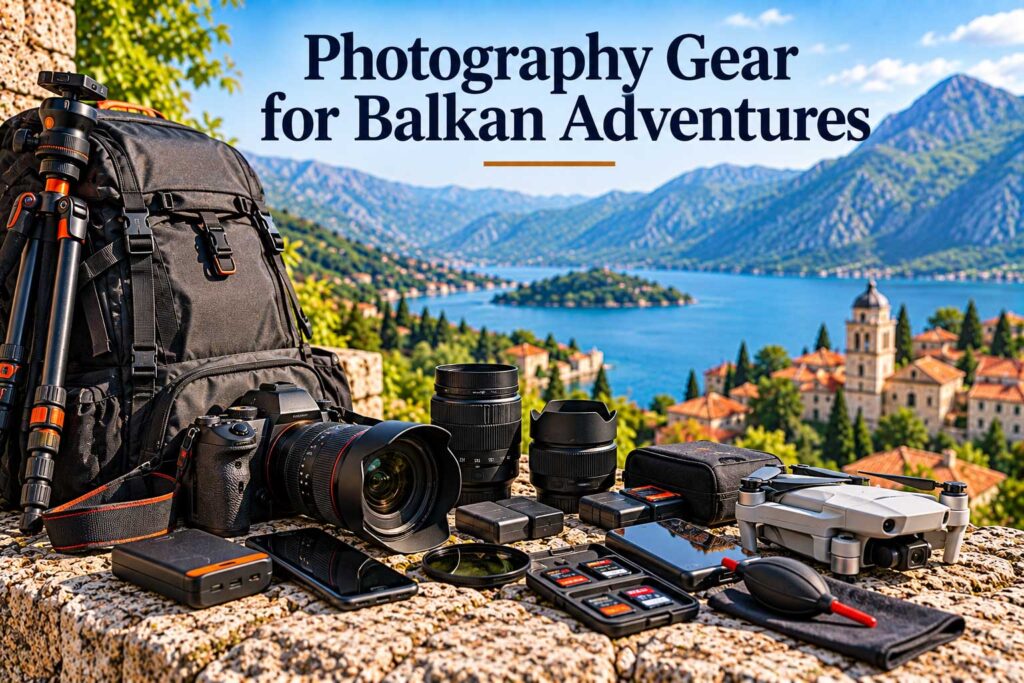
Photography Gear for Balkan Adventures
The Balkans offer plenty to photograph: mountain landscapes, turquoise lakes, medieval fortresses, monasteries, old towns, waterfalls, and long stretches of Adriatic and Aegean coastline.
But you don’t need professional equipment to come home with great photos. For many travelers, a smartphone is the most practical travel camera simply because it’s always within reach. If photography is an important part of your trip, however, a dedicated camera and a few carefully chosen accessories can give you more creative options.
Smartphone or Travel Camera?
Start by deciding whether carrying a separate camera is actually worth it for you.
Modern smartphones are excellent for everyday travel photography, particularly in good light. They’re also much easier to carry when you’re walking all day or trying to travel with one small bag.
A dedicated camera makes more sense if you want greater control over focal length, exposure, low-light photography, RAW files, or specialized subjects such as wildlife.
Remember that you’re carrying the entire system—not just the camera body. A camera, two lenses, batteries, charger, tripod, and protective bag can quickly add considerable weight.
Compact Travel Tripod
A tripod is useful for photography that would otherwise require very slow shutter speeds, including blue-hour cityscapes, night scenes, waterfalls, and some sunrise or sunset compositions.
For travel, size and weight matter more than maximum height. A tripod that’s technically excellent but too heavy to carry will probably spend most of the vacation in your hotel room.
Before setting one up, also pay attention to local rules and your surroundings. Some attractions, museums, historic interiors, and crowded public spaces may restrict tripods or make them impractical to use.
Camera Clip or Comfortable Strap
If you’re hiking with a camera, accessibility matters. A camera buried deep inside your backpack tends to stay there.
A backpack-mounted camera clip can keep it within easy reach while leaving your hands free, although it’s not necessary for everyone. A comfortable crossbody or shoulder strap may work just as well for city sightseeing.
Whatever system you choose, make sure the camera is securely attached before using it on steep or uneven terrain.
Lens Cleaning Kit
You don’t need an elaborate cleaning kit, but a microfiber cloth and small air blower are worth carrying if you’re using a dedicated camera.
Sea spray along the coast, dust on trails, and fingerprints can quickly end up on lenses. Keep a clean microfiber cloth somewhere easily accessible rather than using your shirt or whatever happens to be nearby.
If your camera has interchangeable lenses, take extra care when changing them outdoors in windy or dusty conditions.
Spare Batteries and Memory Cards
These are among the few photography accessories I’d consider genuinely important for anyone carrying a dedicated camera.
A long sightseeing or hiking day can easily outlast one battery, particularly if you’re shooting a lot of video. Carry at least one spare if your camera’s battery life is limited.
The same applies to storage. Rather than relying on a single large memory card for an entire trip, consider carrying a spare and backing up important photos as you travel.
Drone Gear
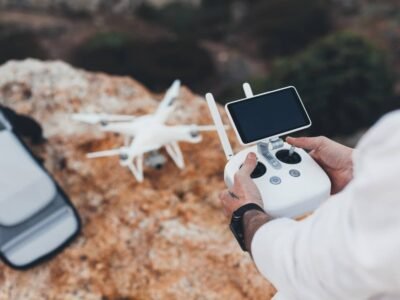
A drone can produce spectacular views of Balkan landscapes, but this is one area where you should check the rules before packing it—and again before each flight. For countries covered by the European aviation framework, start with the official EASA drone guidance, then check the national aviation authority and local flight restrictions for your destination.
If you’re still deciding whether carrying one is worthwhile, compare the options in our guide to the best travel drones.
Drone requirements and restrictions can differ between countries and specific locations. Registration, operator requirements, flight zones, altitude limits, privacy rules, protected areas, airports, and other restrictions may all affect where and how you can legally fly.
Don’t assume that an attractive viewpoint, beach, national park, historic site, or remote-looking landscape is automatically a legal place to launch.
If you do bring a drone, keep the kit simple. Spare batteries and propellers may be useful, but every accessory adds weight. Also check your airline’s current requirements for transporting drone and spare lithium batteries.
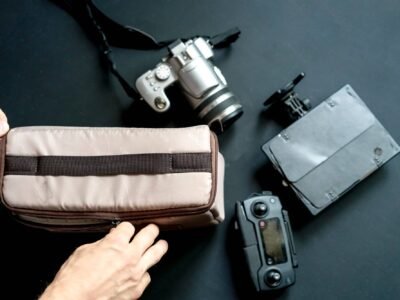
Protective Camera Bag or Insert
You don’t necessarily need a dedicated photography backpack.
For many travelers, a padded camera insert placed inside their regular daypack is more practical. It protects the camera and lenses while allowing you to carry water, an extra layer, snacks, and other everyday items in the same bag.
If you’ll be hiking regularly or carrying several lenses, a dedicated camera backpack may make more sense. Look for comfortable straps, sensible internal organization, and weather protection rather than choosing a bag simply because it has dozens of compartments.
Photography Gear Comparison
| Gear | Best For | Priority |
|---|---|---|
| Smartphone | Everyday travel photography | Enough for many travelers |
| Dedicated camera | Enthusiasts and more creative control | Optional |
| Compact tripod | Night, landscape and long-exposure photography | Itinerary dependent |
| Camera clip or strap | Frequent shooting and hiking | Personal preference |
| Lens cloth and blower | Keeping lenses clean | Useful |
| Spare battery and memory card | Full photography days | Recommended |
| Drone | Aerial photography | Specialized |
| Padded camera insert/bag | Protecting camera equipment | Recommended when needed |
The best photography setup isn’t the one with the most equipment. It’s the one you’re willing to carry and use.
If photography is secondary to the trip, your phone may be all you need. If photography will be a major part of your trip, explore our Balkan photography guides for more equipment and photography ideas. In case you’re specifically traveling to photograph the mountains, coastlines, historic towns, and landscapes of the Balkans, bring the equipment that gives you the creative control you want—but resist packing every accessory you own.
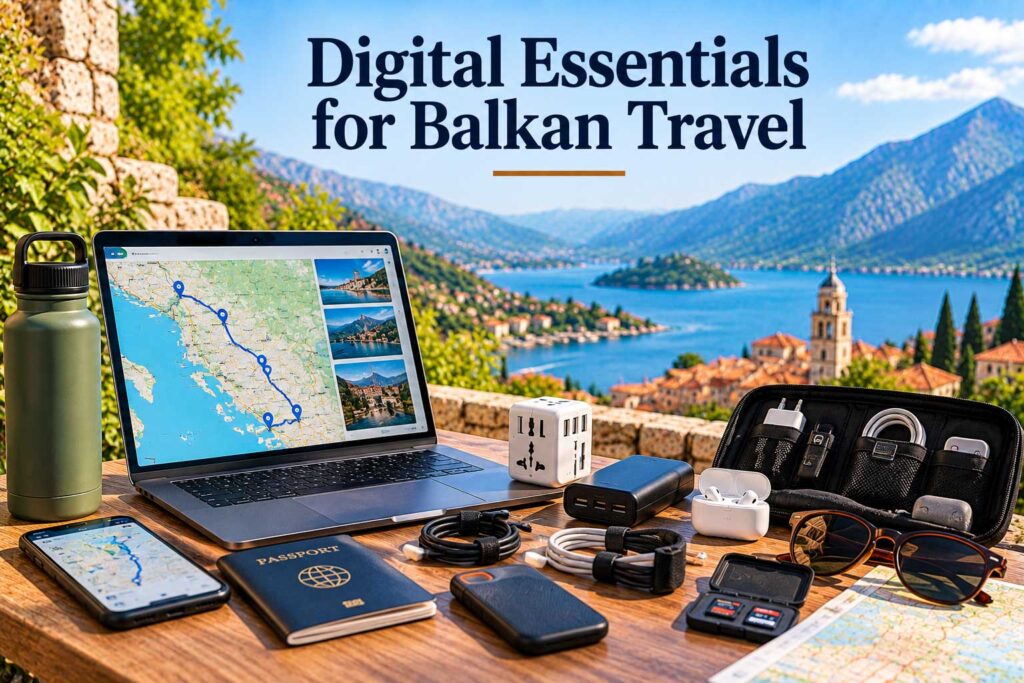
Digital Essentials for Balkan Travel
Your phone will probably become one of the most useful pieces of Balkan travel gear you carry. Maps, accommodation details, transportation tickets, translation tools, weather forecasts, banking, and reservations can all end up in one device.
The problem is that travel doesn’t always go according to plan. Mobile coverage can disappear, roaming can change when you cross a border, and a dead or lost phone can suddenly leave you without information you assumed would always be available.
A little preparation before the trip goes a long way.
Download Offline Maps Before You Need Them
Don’t wait until you’re halfway up a mountain road with no signal to think about offline navigation.
Download maps for the areas you’ll be visiting while you have reliable Wi-Fi. This can be especially useful on road trips, in mountain regions, and when crossing between countries where your mobile-data arrangement may change.
Also save the locations of your accommodation, parking areas, bus stations, trailheads, and other places you know you’ll need to find.
Keep in mind that offline functionality varies between mapping apps. Driving directions, walking routes, public transportation information, and hiking trails may not all remain available without a connection, so check what your chosen app actually supports before relying on it.
Keep Important Travel Information Available Offline
You don’t need to print every booking confirmation, but don’t leave all of your important information trapped inside an email account that requires internet access.
Save copies of anything you might urgently need, including your passport identification page, travel insurance details, transportation reservations, accommodation addresses, and rental-car documents.
Protect sensitive copies appropriately rather than leaving passport images sitting openly in your phone’s photo gallery.
For particularly important information, keeping a secure backup somewhere other than your phone gives you another option if the device is lost, stolen, or damaged.
Set Up Your Accounts Before Leaving Home
Travel is a bad time to discover that you can’t remember an important password or that a login requires access to a phone number you can’t currently use.
A reputable password manager can make it easier to maintain unique passwords and access your accounts while traveling. Set it up before departure rather than experimenting with a new security system while you’re already abroad.
Also review the authentication methods for important accounts such as email and banking. Where appropriate, make sure you have a secure backup method if your primary phone or SIM becomes unavailable.
Install Only the Travel Apps You’ll Actually Use
There’s no reason to fill your phone with dozens of apps before a Balkan trip.
Start with what your itinerary requires. That may include a mapping app, translation tool, airline app, weather service, accommodation platform, and any transportation apps relevant to the countries you’re visiting.
If you’re traveling across several Balkan countries, don’t assume the same ride-hailing, taxi, public transportation, or payment apps will work everywhere. Services vary considerably between destinations.
Download necessary apps and sign in before leaving home so you aren’t trying to create accounts while standing at an airport or bus station.
Prepare More Than One Way to Pay
Payment habits vary across the Balkans. Cards and contactless payments are common in many cities and tourist areas, while cash remains useful—and sometimes necessary—in smaller businesses, markets, rural areas, and certain transportation situations.
Carry more than one payment card if possible and store your backup separately.
Also remember that the Balkans do not share a single currency. Some countries use the euro, while others have their own currencies. Check the currency used in each country on your itinerary rather than assuming euros will work everywhere.
Before departure, review your cards’ foreign transaction fees, international ATM fees, and any travel-notification requirements your bank may have.
Protect the Phone You’re Depending On
If your phone is handling navigation, reservations, communication, tickets, and photography, losing or breaking it becomes much more than an inconvenience.
A protective case is usually enough for ordinary sightseeing. A waterproof pouch may be useful if your itinerary includes kayaking, rafting, beaches, or boat trips, while a power bank helps during long days away from an outlet.
You don’t need to buy every phone accessory marketed to travelers. Protect against the risks that actually apply to your itinerary.
Back Up Important Photos
You don’t need an elaborate professional backup system for ordinary vacation photos, but relying on a single phone, camera, or memory card for an entire trip isn’t ideal.
Automatic cloud backup is convenient when you have reliable Wi-Fi. Photographers carrying larger amounts of data may prefer an additional memory card, laptop, or portable storage device.
The more important the photographs are to you, the more sense it makes to keep another copy somewhere separate from the original device.
Digital Travel Checklist
| Digital Essential | Why It Helps | Priority |
|---|---|---|
| Offline maps | Navigation when data is unavailable | Highly useful |
| Offline travel documents | Access to important information | Important |
| Password/account preparation | Avoid login problems abroad | Recommended |
| Essential travel apps | Navigation, transport and bookings | Itinerary dependent |
| Backup payment method | Alternative if a card fails or is lost | Important |
| Phone protection | Protect a device you rely on heavily | Recommended |
| Photo backup | Avoid losing trip photos | Recommended |
The goal isn’t to turn your phone into a complicated travel command center. It’s to make sure the information you genuinely depend on remains accessible when Wi-Fi, mobile data, a payment card, or even the phone itself doesn’t cooperate.
Download the essentials before departure, keep backups of important information, and then spend less time managing technology once you’re actually in the Balkans.
Packing Tips for the Balkans
Packing for the Balkans becomes much easier once you stop preparing for every possible situation and start packing for your actual itinerary.
A two-week trip through several countries may involve buses, ferries, apartment stairs, rental cars, and frequent hotel changes. In that situation, being able to comfortably handle your own luggage matters more than having an outfit for every occasion.
Here are a few practical ways to keep your Balkans packing list under control.
Pack for About a Week, Not the Entire Trip
If you’re traveling for two or three weeks, you probably don’t need two or three weeks of clothing.
Pack a small group of items that work together and plan to do laundry during the trip. This is particularly useful on multi-country itineraries because you’ll have less luggage to move every few days.
Think in layers rather than individual outfits. A few shirts, comfortable bottoms, one warmer layer, and a lightweight rain shell can cover a surprising range of conditions.
Decide What You’ll Wear Before Adding More
One simple way to prevent overpacking is to lay everything out before putting it into your bag.
If an item only works with one outfit, requires special shoes, or you’re packing it “just in case,” reconsider whether it deserves the space.
This doesn’t mean everything has to be technical travel clothing. Pack clothes you actually enjoy wearing. You’ll probably reach for those more often than something purchased solely because it was advertised as travel gear.
Roll, Fold, or Use Packing Cubes—Whatever Works
There’s no universal rule that you have to roll every piece of clothing.
Rolling works well for some items, while folding works better for others. Packing cubes can help keep categories separated, especially when you’re changing accommodations frequently.
The important part is creating a system that lets you find what you need without unpacking your entire suitcase every night.
And remember: compression can create more room, but it doesn’t make your luggage weigh less.
Keep Important Items in Your Carry-On
If you’re checking luggage, keep anything difficult or expensive to replace with you whenever airline rules permit.
That generally includes your passport and other essential documents, medications, wallet, phone, important electronics, and keys.
It’s also useful to keep enough basic necessities in your carry-on to get through the first day if your checked bag is delayed. That might mean a clean shirt, underwear, basic toiletries, and any medication you can’t go without.
Check current airline and security restrictions for anything you’re unsure about, particularly batteries, liquids, and specialized equipment.
Leave a Little Empty Space
You don’t need to fill every available centimeter of your suitcase before leaving home.
The Balkans are full of local crafts, foods, textiles, and regional products you may want to bring home. Bulgaria’s rose products, handmade ceramics, local textiles, olive products from coastal regions, and small artisan goods are just a few examples.
Before buying food, liquids, alcohol, plants, or agricultural products to take home, check the customs and airline rules that apply to your destination.
A small foldable tote can also be useful during the trip without taking much room in your main luggage.
If you’re looking for other small additions that won’t take over your suitcase, see our guide to practical travel accessories for women.
Weigh and Measure Your Bags Before Flying
Don’t assume that a bag described as “carry-on size” will qualify on every airline you use.
Baggage dimensions, weight allowances, and personal-item rules vary by airline and fare. This matters particularly if your Balkan itinerary involves several separate flights.
Check the allowance for each airline on your itinerary, not just the carrier bringing you to Europe.
A small luggage scale can be useful if you’re close to the limit, especially after buying souvenirs.
Think About Border Crossings Before a Road Trip
Multi-country road trips are one of the best ways to explore the Balkans, but crossing a border by car involves more than simply having your passport handy.
Before leaving, check the entry requirements for your nationality and every country on your route. U.S. travelers can start with the State Department’s country information pages, then verify any destination-specific requirements that apply to the trip. If you’re using a rental car, confirm that the rental agreement permits travel into each country you plan to visit and ask what documentation or insurance is required for cross-border driving.
Don’t assume that permission to drive in one Balkan country automatically extends to neighboring countries.
Keep the necessary documents somewhere accessible rather than buried at the bottom of your luggage when you reach the border.
Do a Final “Would I Actually Use This?” Check
Once you’ve finished packing, go through the bag one more time.
Take a second look at duplicate shoes, bulky toiletries, extra electronics, excessive “just in case” clothing, and specialized gear for activities you haven’t actually planned.
Removing even a few unnecessary items can make a noticeable difference when you’re carrying your bag up apartment stairs or moving between destinations.
Quick Balkan Packing Checklist
| Category | Start With |
|---|---|
| Clothing | Versatile layers and comfortable footwear |
| Electronics | Phone, necessary chargers and power bank |
| Documents | Passport and trip-specific documents |
| Health | Personal medications and basic first aid |
| Outdoor | Water, sun protection and activity-specific gear |
| Organization | Packing cubes or pouches if useful |
A good Balkan road trip packing list or multi-country packing list shouldn’t be enormous. It should match the weather, transportation, activities, and destinations you’ve actually planned.
If you’re debating whether to bring something, ask yourself one question: “When exactly am I going to use this?” If you don’t have a good answer, it can probably stay at home.
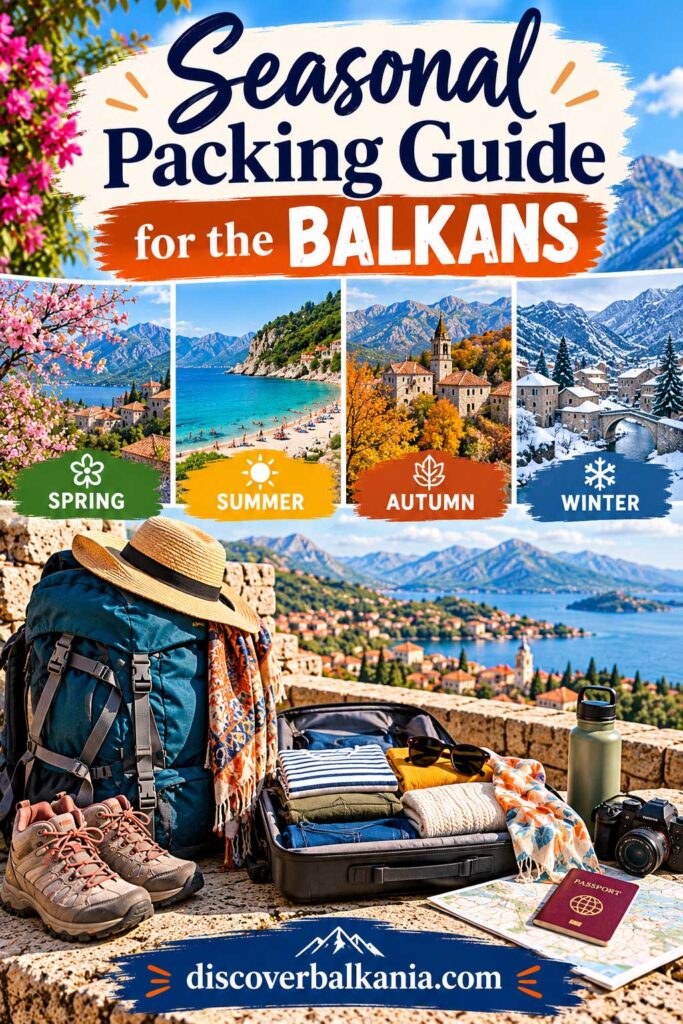
Seasonal Packing Guide for the Balkans
There isn’t one Balkan climate, which is why the time of year is only part of the packing equation.
The Adriatic and Aegean coasts, inland cities, mountain ranges, and higher-elevation villages can experience very different conditions at the same time. A warm day beside the sea doesn’t tell you what the weather will be like a few hours away in the mountains.
Use the seasons below as a starting point, then check the forecast and elevation for the specific destinations on your itinerary before you pack.
Spring: March–May
Spring can be particularly difficult to generalize because conditions change considerably from March to May.
Coastal and lower-elevation destinations may already feel pleasantly mild while mountain areas remain much colder. Snow can persist at higher elevations, and some hiking routes may not yet be suitable for ordinary warm-weather hiking.
For a typical sightseeing trip, build your wardrobe around layers. Long pants, shirts you can layer, a fleece or sweater, comfortable walking shoes, and a lightweight waterproof jacket give you room to adjust throughout the day.
If hiking is part of the trip, research the current trail conditions rather than assuming that spring weather in a nearby city reflects conditions in the mountains.
Summer: June–August
Summer packing is usually straightforward for coastal destinations: lightweight clothing, comfortable shoes or sandals, swimwear, a hat, sunglasses, and good sun protection.
If Albania is part of your summer itinerary, our guide to the best beaches in Albania can help you decide how much beach time to build into the trip.
The challenge comes when you combine the coast with inland cities or mountains.
Places along the Adriatic and Aegean can become very hot during summer, and inland cities may also experience periods of intense heat. Mountain destinations can feel considerably different, particularly early in the morning, after sunset, or when weather moves through.
If your itinerary combines beaches and hiking, don’t pack exclusively for the coast. Bring a light layer and appropriate footwear for the mountain portion of the trip.
Travelers spending more time along the Adriatic can also compare the best beaches in Croatia before deciding which coastal stops belong on the itinerary.
Also consider where you’ll be visiting. Some religious sites may expect more modest clothing than you’d normally wear at the beach, so having something that covers your shoulders and knees can be useful.
For an island-focused trip, our guide to the best islands in Croatia can help you compare destinations before deciding what to pack.
Autumn: September–November
Like spring, autumn changes significantly as the season progresses.
Early September can still feel very summery in coastal areas, while conditions become cooler and less predictable as you move later into autumn or higher into the mountains.
Layers become increasingly useful: long pants, a sweater or fleece, comfortable closed-toe shoes, and a waterproof outer layer can cover many sightseeing situations.
If you’re traveling specifically for autumn hiking or photography, remember that daylight becomes shorter as the season progresses. Check sunset times and trail conditions before longer outdoor days.
Winter: December–February
Winter requires the most destination-specific planning.
Mountain resorts and inland areas can experience snow, freezing temperatures, and icy conditions, while some coastal destinations have considerably milder winters. That doesn’t necessarily mean the coast will feel warm—wind and rain can make conditions feel colder than the temperature alone suggests.
For genuinely cold destinations, bring an insulated jacket, warm base or mid layers, gloves, a hat, warm socks, and footwear appropriate for the expected conditions.
If skiing or snowboarding is the purpose of the trip, check what equipment can be rented locally before transporting bulky winter-sports gear from home.
Winter also brings shorter daylight hours, which is worth considering when planning road trips, hikes, and sightseeing days.
Balkan Seasonal Packing at a Glance
| Season | What to Prepare For | Useful Starting Point |
|---|---|---|
| Spring | Rapid changes, rain and colder mountains | Layers + waterproof shell |
| Summer | Heat, strong sun and cooler elevations | Lightweight clothing + sun protection + light layer |
| Autumn | Warm early-season days changing to cooler conditions | Layers + waterproof shell |
| Winter | Snow and cold inland/mountains; milder but variable coast | Destination-specific winter clothing |
Packing for a Trip With Multiple Climates
This is where Balkan packing becomes interesting.
You could spend part of a trip swimming along the Adriatic and another part hiking at considerably higher elevations. Instead of packing two completely separate wardrobes, build around pieces that work together.
A lightweight rain shell can go over a T-shirt in warm rain or over a fleece when it’s cold. Hiking or travel pants can work for both outdoor activities and casual sightseeing. One warmer layer can handle mountain evenings without requiring a bulky jacket during a summer trip.
Most importantly, check the weather again shortly before departure. Seasonal averages can help with planning, but the actual forecast for Dubrovnik, Sarajevo, Sofia, Theth, Durmitor, or the Rila Mountains is far more useful when you’re deciding what belongs in your suitcase.
The best answer to what to pack for the Balkans is ultimately determined by three things: where you’re going, when you’re going, and what you’ll be doing once you get there.
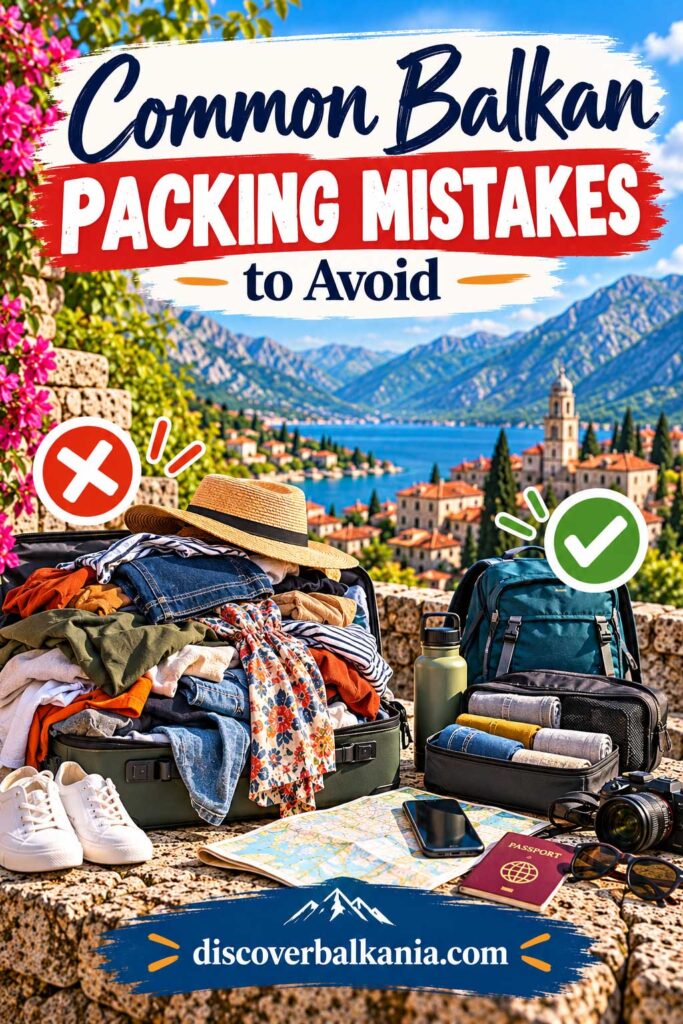
Common Balkan Packing Mistakes to Avoid
Most packing problems don’t come from forgetting some obscure travel gadget. They come from bringing too much, preparing for the wrong conditions, or assuming something will work the same way everywhere on your trip.
Before closing your suitcase, check that you’re not making one of these common mistakes.
Packing for Every Possible Situation
It’s easy to overpack when one trip includes cities, beaches, mountains, and several countries.
You don’t need separate clothing for every destination. Build around versatile layers and add specialized gear only for activities you know you’ll be doing.
If you’re packing something solely because you might need it, consider whether it would be easy to buy or borrow locally if that unlikely situation actually occurs.
Bringing Shoes You Haven’t Tested
The cobbled streets, hills, stairs, and long sightseeing days found throughout the Balkans can quickly expose uncomfortable footwear.
Don’t make the first day of your vacation the first time you wear your new walking shoes or hiking boots. Wear them at home first and make sure they’re comfortable for longer walks.
For most travelers, two useful pairs of shoes are better than four pairs for different outfits.
Packing for the Coast but Forgetting the Mountains
A sunny forecast for Split or Dubrovnik doesn’t tell you what conditions will be like several hours away at higher elevations.
If your itinerary includes mountain destinations, check those forecasts separately. Even during warmer months, a lightweight outer layer can be useful when conditions change.
The reverse applies in winter: don’t pack for a snowy mountain destination and assume you’ll need exactly the same clothing everywhere else on your route.
Assuming Every Airline Has the Same Baggage Rules
This is an easy mistake on a multi-country trip. Your transatlantic flight and a shorter European flight may have completely different carry-on allowances.
If you’re using several airlines, check the baggage rules for each flight separately rather than assuming the first airline’s limits apply to the rest of your trip.
Relying on One Payment Method
Don’t make a single credit card your entire financial plan.
Cards are convenient in many destinations, but cash can still be useful or necessary depending on where you’re traveling and what you’re buying. Carry a second payment method and keep the backup somewhere separate from your everyday wallet.
And remember that the Balkans use multiple currencies, so check what you’ll actually need in each country.
Putting Essential Medication in Checked Luggage
Keep essential medications with you during flights whenever regulations permit rather than placing everything in checked baggage.
Bring an appropriate supply for the trip and check any rules that apply to the medications you’re carrying, particularly when crossing international borders.
If you take prescription medication, research the requirements before departure rather than assuming the rules will be identical in every country.
Buying Travel Insurance Without Reading the Policy
Having travel insurance and having the right coverage for your trip aren’t necessarily the same thing.
Read the policy rather than choosing solely by price. Pay particular attention to coverage and exclusions that matter for your itinerary, especially if you’re planning activities such as hiking, skiing, rafting, renting a car, or participating in adventure sports.
Keep the policy details and emergency contact information somewhere you can access during the trip.
Depending Completely on Mobile Data
Don’t assume you’ll have a reliable connection everywhere you go.
Before heading out, save your accommodation address and any maps, tickets, or reservations you’ll need that day so you can still access the basics if your connection disappears.
Packing Mistakes at a Glance
| Mistake | Better Approach |
|---|---|
| Packing for every possibility | Pack for your actual itinerary |
| Wearing untested shoes | Break them in before departure |
| Checking only one weather forecast | Check each destination and elevation |
| Assuming baggage rules are universal | Verify every airline separately |
| Relying on one card | Carry a separate backup payment method |
| Checking essential medication | Keep important medication accessible |
| Buying insurance without reading it | Check coverage and exclusions |
| Depending entirely on mobile data | Save essential information offline |
A good travel gear checklist shouldn’t be based on how many things you can fit into a suitcase. It should help you eliminate the items you won’t use while making sure the things that genuinely matter are covered.
Before departure, review your itinerary one final time and remove anything that doesn’t have a clear purpose. Packing fewer things—and choosing them more carefully—is usually the better strategy.
Frequently Asked Questions About Travel Gear for the Balkans
What is the most important travel gear for the Balkans?
For most trips, start with comfortable walking shoes, versatile clothing layers, a lightweight waterproof jacket, a daypack, a reusable water bottle, a phone charger, and a power bank.
Beyond those basics, the best travel gear for the Balkans depends on your itinerary. A summer beach trip through Croatia and Montenegro requires very different equipment from a hiking trip through Albania, Bulgaria, or Romania.
Do I need hiking gear for the Balkans?
Not unless hiking is actually part of your plans.
Comfortable walking shoes are sufficient for most city sightseeing and easy walks. If you’re planning longer or more demanding routes in places such as the Albanian Alps, Bulgaria’s Rila or Pirin Mountains, Montenegro’s Durmitor National Park, or the Carpathians, choose footwear and equipment appropriate for the specific trail and conditions.
Check current trail and weather conditions before heading into mountain areas rather than relying solely on a general packing list.
Is a suitcase or backpack better for traveling through the Balkans?
Both can work.
A backpack is convenient for multi-country trips involving frequent accommodation changes, stairs, buses, ferries, and historic centers with cobblestone streets. A wheeled suitcase can be perfectly practical if you’re staying longer in each destination or traveling mainly by rental car.
Choose the luggage you’ll be comfortable handling yourself throughout the trip.
Should I bring cash to the Balkans?
It’s useful to carry some cash rather than relying entirely on cards.
Cards and contactless payments are widely used in many cities and tourist areas, but cash may still be needed at smaller businesses, markets, rural destinations, or for certain transportation and services.
Don’t assume the entire region uses the same currency. Several Balkan countries have their own currencies, so check what is used in each destination on your itinerary.
What type of power adapter do I need for the Balkans?
Type C and Type F plugs are common across much of the region, but you should check the plug type for each country you’re visiting.
If you’re traveling from North America, the UK, or another region with different plugs, a compact universal adapter can be convenient on a multi-country trip.
Remember that a plug adapter changes the physical connection—it doesn’t convert voltage. Check that your electrical devices support the local voltage before using them.
Is the Balkans safe for solo travelers?
Safety conditions vary by destination, activity, and current circumstances, so it’s better not to treat the entire Balkan region as a single destination.
For an independent trip, use ordinary travel precautions: secure valuables, research transportation before arriving somewhere unfamiliar, keep important information available offline, and check current local guidance and the U.S. Department of State travel advisories for the countries on your itinerary.
Solo hikers should take additional precautions appropriate to the route, weather, terrain, and remoteness of the area.
How much luggage should I bring?
For many travelers, carry-on luggage plus a small daypack can be enough for a one- or two-week trip if you’re willing to do laundry.
A 35–45 liter travel backpack is a popular range, but don’t assume a backpack of that capacity automatically qualifies as carry-on luggage. Airline limits are based on dimensions and weight, and allowances can vary considerably.
Check every airline on your itinerary before choosing your bag.
When is the best time to visit the Balkans?
There isn’t one best season for the entire region.
Summer is popular for beaches and islands along the Adriatic and Aegean, while spring and autumn can work well for sightseeing and some outdoor activities. Winter brings opportunities for skiing and other cold-weather trips in mountain destinations.
Conditions vary considerably between the coast, inland areas, and higher elevations, so choose your travel dates based on the countries and activities you’re most interested in rather than the region as a whole.
What should I avoid overpacking for a Balkan trip?
Start with duplicate shoes, excessive toiletries, too many outfits, and gadgets you rarely use at home.
It’s easy to overprepare when your itinerary includes several countries, but most travelers need fewer specialized products than travel packing lists suggest. Pack versatile essentials first, then add equipment for specific activities such as hiking, photography, skiing, or water sports.
If you can’t identify when you’ll realistically use something, that’s usually a good sign it can stay at home.
Read More Balkan Travel Guides
Planning the rest of your trip? These Discover Balkania guides can help you choose destinations, plan your route, and prepare for different types of Balkan adventures.
- Best Practical Travel Accessories for Women – More useful travel accessories for staying organized and comfortable without overpacking.
- Best Travel Drones – Compare travel-friendly drones if aerial photography will be part of your Balkan trip.
- Best Travel Gadgets – Discover additional electronics and practical gadgets for flights, road trips, and longer journeys.
- Best Beaches in Albania – Explore Albania’s Adriatic and Ionian coastline and find beach destinations to add to your itinerary.
- Best Islands in Croatia – Compare Croatian islands for beaches, historic towns, outdoor activities, and island-hopping trips.
- 10 Best Beaches in Croatia – Find beautiful Croatian beaches worth adding to a summer Balkan itinerary.
- Most Popular Cities in Bulgaria – Discover Sofia, Plovdiv, Veliko Tarnovo, Varna, Burgas, and other Bulgarian cities worth visiting.
Final Thoughts: Choosing the Best Travel Gear for the Balkans
The best travel gear for the Balkans isn’t the longest list of gadgets you can fit into a suitcase. It’s the small collection of things that makes sense for the trip you’re actually taking.
Start with the basics: comfortable footwear, versatile layers, dependable luggage, a waterproof outer layer, essential electronics, and the documents you need. Then look at your itinerary. Add hiking equipment if you’re heading into the mountains, photography gear if capturing the trip is a priority, or beach essentials if most of your time will be spent along the coast.
Before departure, check the weather for each destination, review your airlines’ baggage rules, confirm border and entry requirements, and remove anything you’re unlikely to use.
You can always buy a forgotten everyday item along the way. What matters more is being able to comfortably handle the luggage you bring.
Pack for your itinerary, leave a little room for the unexpected, and let the Balkans—not your suitcase—be the focus of the trip.
What's your reaction?