 By
By 15 Best Travel Drones
Travel drones have changed the way we capture the places we visit. Instead of coming home with only photos taken from the ground, you can now photograph coastlines, mountain roads, islands, historic towns, and remote landscapes from an entirely different perspective.
And you no longer need a huge professional drone to do it. Some of the best travel drones are small enough to fit into a backpack, with several popular models weighing less than 250 grams. Despite their compact size, today’s drones can offer 4K video, stabilized cameras, intelligent tracking, obstacle detection, and surprisingly long flight times.
But the best drone for one traveler won’t necessarily be the best choice for another. If you’re hiking through the mountains, weight and battery life may matter most. For road trips, you might prefer a larger drone with better wind resistance and camera performance. And if you’re buying your first drone, simple controls and reliable safety features can be more useful than advanced professional settings.
If you’re still preparing the rest of your kit, our Travel Gear for the Balkans guide covers other useful equipment to consider before your trip.
There are also practical things to think about before taking a drone on a trip, including airline battery rules, local flight restrictions, registration requirements, and where you’re actually allowed to fly.
In this guide, we’ve rounded up 15 of the best travel drones for 2026, from lightweight beginner-friendly models to more advanced options for photographers and filmmakers. We’ll compare camera quality, weight, flight time, portability, safety features, and overall value so you can find a drone that makes sense for the way you travel.
How We Chose the Best Travel Drones
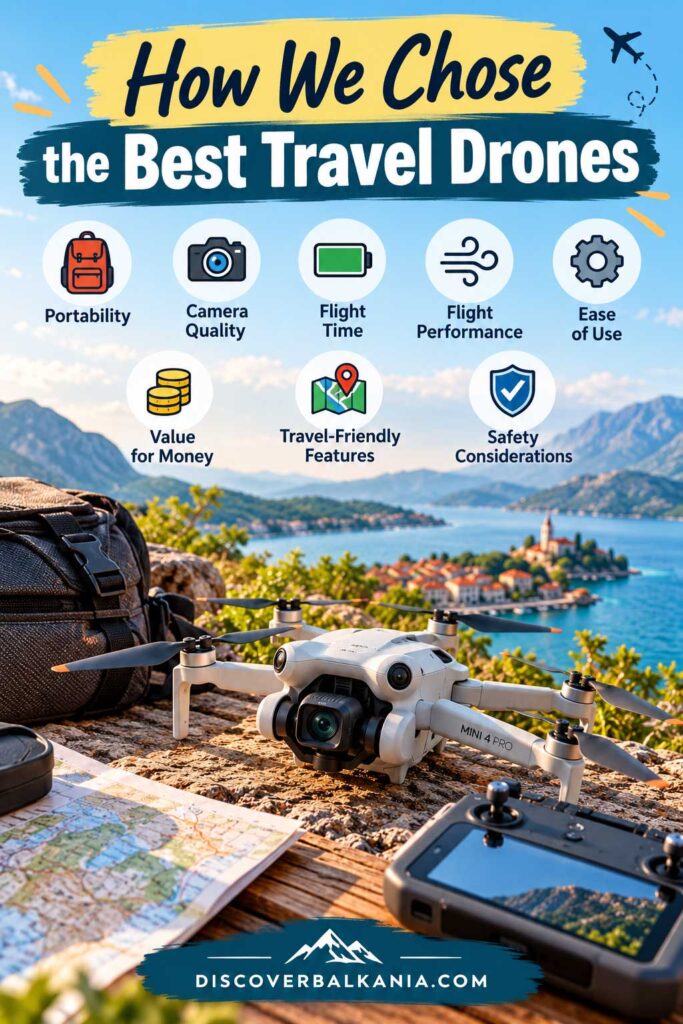
Not every good drone makes a good travel drone. Some deliver incredible image quality but are simply too large or heavy to carry around all day. Others are wonderfully compact but give up too much in camera quality, battery life, or flight performance.
For this guide, we compared the features and specifications that are especially important when you’re taking a drone on the road.
Portability
Size and weight matter when you’re already carrying clothes, electronics, camera equipment, and other travel essentials. We favored compact drones that are easy to fit into a backpack or carry-on, with extra consideration given to lightweight and foldable models.
Camera Quality
A travel drone should capture footage that’s worth bringing home. We looked at video resolution, photo capabilities, stabilization, sensor specifications, and other camera features that can make a noticeable difference when shooting landscapes, coastlines, cities, and outdoor adventures.
Flight Time
Nobody wants to reach a spectacular viewpoint only to discover that the drone battery is almost dead. We compared manufacturer-rated flight times while keeping in mind that actual flight time can be shorter depending on wind, temperature, flight speed, and other conditions.
Flight Performance and Safety
Travel can put a drone into very different environments. One day you might be flying along a calm coastline and the next from a windy mountain viewpoint. GPS positioning, wind resistance, obstacle sensing, Return-to-Home features, and overall flight stability were therefore important considerations.
Ease of Use
Not everyone traveling with a drone is an experienced pilot. Features such as automatic takeoff and landing, subject tracking, intelligent flight modes, obstacle detection, and Return-to-Home can make flying considerably easier, especially for beginners.
Value for Money
The most expensive drone isn’t automatically the right choice. We included everything from relatively affordable beginner models to premium drones for serious photographers and filmmakers, with an emphasis on what each model offers for its price.
Travel-Friendly Features
We also considered practical features that can make a noticeable difference on the road, including:
- Lightweight construction
- Compact or foldable designs
- USB-C charging where available
- Easy setup and packing
- Replacement battery availability
- Accessible spare parts and accessories
- Reliable controller and app support
Ultimately, the best travel drone depends on how and where you plan to use it. A backpacker may prioritize low weight above everything else, while a photographer may happily carry a larger drone for better camera performance. Our picks reflect those different needs rather than assuming that one model is right for every traveler.
Affiliate Disclosure: This post may contain affiliate links, which means we may earn a small commission if you make a purchase through our links at no extra cost to you. We only recommend products we believe can provide value to our readers and improve their travel experience.
Quick Comparison: Best Travel Drones in 2026
If you don’t want to work through all 15 options right away, start with this comparison. It highlights the main differences in camera capability, weight, and manufacturer-rated flight time, along with the type of traveler each drone is likely to suit best.
| Drone | Best For | Camera | Max Flight Time* | Weight |
|---|---|---|---|---|
| DJI Mini 4 Pro | Lightweight all-around travel | 4K HDR | Up to 34 min** | Under 249 g |
| DJI Air 3S | Serious travel photography | Dual-camera system | Up to 45 min | 724 g |
| DJI Flip | Beginners and casual travel | 4K | Up to 31 min | Under 249 g |
| DJI Mini 3 | Value-focused travelers | 4K HDR | Up to 38 min | Under 249 g |
| DJI Neo | Ultra-light travel and quick videos | 4K | Up to 18 min | 135 g |
| DJI Avata 2 | Immersive FPV footage | 4K | Up to 23 min | 377 g |
| Autel EVO Lite+ | Low-light photography | Up to 6K | Up to 40 min | 835 g |
| Autel EVO Nano+ | Compact DJI alternative | 4K | Up to 28 min | 249 g |
| Potensic ATOM 2 | Budget-conscious travelers | 4K | Up to 32 min | Under 249 g |
| Holy Stone HS900 | Affordable GPS flying | 4K | Up to 30 min | Around 249 g |
| HOVERAir X1 PRO | Hands-free travel videos | 4K | Up to 16 min | 191.5 g |
| DJI Mavic 3 Pro | Professional filmmaking | Triple-camera system | Up to 43 min | 958 g |
| EXO Mini Pro | Lightweight alternative | 4K | Up to 40 min | Around 249 g |
| DJI Mini 4K | Complete beginners | 4K | Up to 31 min | Under 249 g |
| Potensic ATOM SE | Entry-level travel | 4K | Up to 31 min | Under 249 g |
*Flight times are manufacturer maximums measured under specific test conditions. Real-world flight time can be shorter depending on wind, temperature, altitude, flight speed, battery condition, and other factors.
**DJI rates the Mini 4 Pro for up to 34 minutes with the standard Intelligent Flight Battery. An optional Intelligent Flight Battery Plus can extend the manufacturer’s rated maximum, but it also increases the aircraft’s weight above 249 grams.
The biggest decision is usually between portability and camera performance. Sub-250 g models such as the DJI Mini 4 Pro, DJI Flip, and DJI Mini 3 are easier to carry when you’re moving frequently, while larger models such as the DJI Air 3S and Mavic 3 Pro give photographers and filmmakers more advanced imaging options.
Don’t choose on specifications alone, though. Local drone regulations, where you plan to fly, how much equipment you’re willing to carry, and your experience level can matter just as much as camera resolution or maximum flight time.
1. DJI Mini 4 Pro – Best Overall Travel Drone
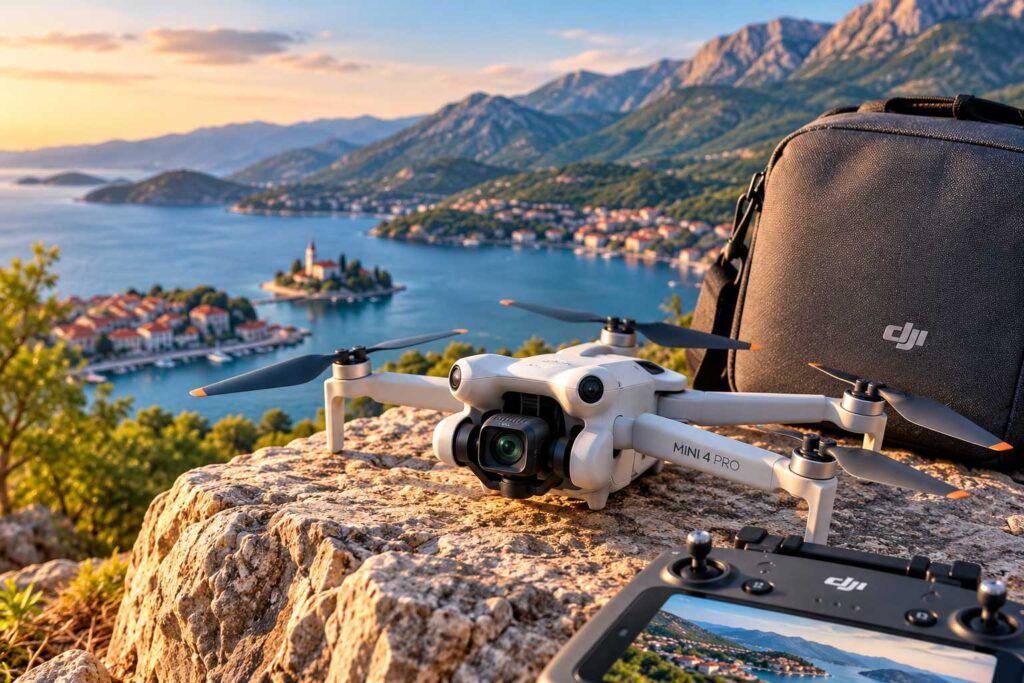
The DJI Mini 4 Pro is a strong choice for travelers who want a capable camera drone without adding much weight to their luggage. It weighs less than 249 grams with the standard battery, folds down to a compact size, and still offers many of the camera and flight features normally associated with larger drones.
Its camera can capture 4K HDR video and photos at up to 48 MP, while a three-axis gimbal keeps footage stable during flight. The Mini 4 Pro also includes omnidirectional obstacle sensing, ActiveTrack 360°, and several automated shooting modes that can be particularly useful when you’re traveling and don’t have much time to set up a complicated shot.
Portability is arguably its biggest advantage. It’s small enough to carry on a hike or keep in a daypack while exploring, yet capable enough for landscapes, coastlines, road trips, and travel videos.
One thing to remember is that weighing less than 250 grams doesn’t automatically mean you can fly anywhere or avoid every registration requirement. Drone rules vary by country and can also depend on how and where you’re flying, so check the regulations for your destination before takeoff.
Why It Stands Out
- Weighs under 249 g with the standard battery
- Records 4K HDR video
- Captures photos at up to 48 MP
- Three-axis mechanical gimbal
- Omnidirectional obstacle sensing
- ActiveTrack 360° subject tracking
- Compact, foldable design
- Up to 34 minutes of manufacturer-rated flight time with the standard battery
- Useful automated shooting modes for beginners and experienced pilots
Pros and Cons
| Pros | Cons |
|---|---|
| ✓ Compact and lightweight at under 249 g with the standard battery | ✗ More expensive than basic beginner drones |
| ✓ Strong 4K video and photo capabilities | ✗ Extra batteries and accessories increase the total cost |
| ✓ Omnidirectional obstacle sensing | ✗ Larger drones may perform better in demanding conditions |
| ✓ ActiveTrack 360° subject tracking | ✗ Optional higher-capacity battery pushes the weight above 249 g |
| ✓ Three-axis mechanical gimbal for stable footage | |
| ✓ Foldable and easy to carry in a backpack | |
| ✓ Good range of intelligent flight features |
DJI Mini 4 Pro Specifications
| Feature | Details |
|---|---|
| Video | Up to 4K |
| Photo Resolution | Up to 48 MP |
| Weight | Under 249 g with standard battery |
| Max Flight Time* | Up to 34 minutes |
| Gimbal | 3-axis mechanical |
| Obstacle Sensing | Omnidirectional |
| Subject Tracking | ActiveTrack 360° |
| Foldable | Yes |
*Flight time is based on DJI’s testing under specified conditions. Actual flight time varies with wind, temperature, flight speed, battery condition, and other factors.
Best For
The DJI Mini 4 Pro makes the most sense for travelers who want one compact drone that can handle a wide range of situations. It’s particularly well suited to vacations, road trips, hiking, travel photography, YouTube videos, and other trips where luggage space matters.
Beginners can take advantage of its automated features and obstacle sensing, while more experienced pilots have access to considerably more camera and flight control than they’ll find on a basic entry-level drone.
Bottom Line
The DJI Mini 4 Pro stands out because it manages to pack an unusually broad set of features into a drone weighing less than 249 grams. You get a capable camera, three-axis stabilization, obstacle sensing, subject tracking, and a compact folding body without having to carry a much larger aircraft.
It isn’t the cheapest travel drone, and photographers who prioritize maximum image quality may prefer a larger model such as the DJI Air 3S. But for travelers who put a premium on portability without giving up advanced camera and flight features, the Mini 4 Pro is one of the most compelling options to consider.
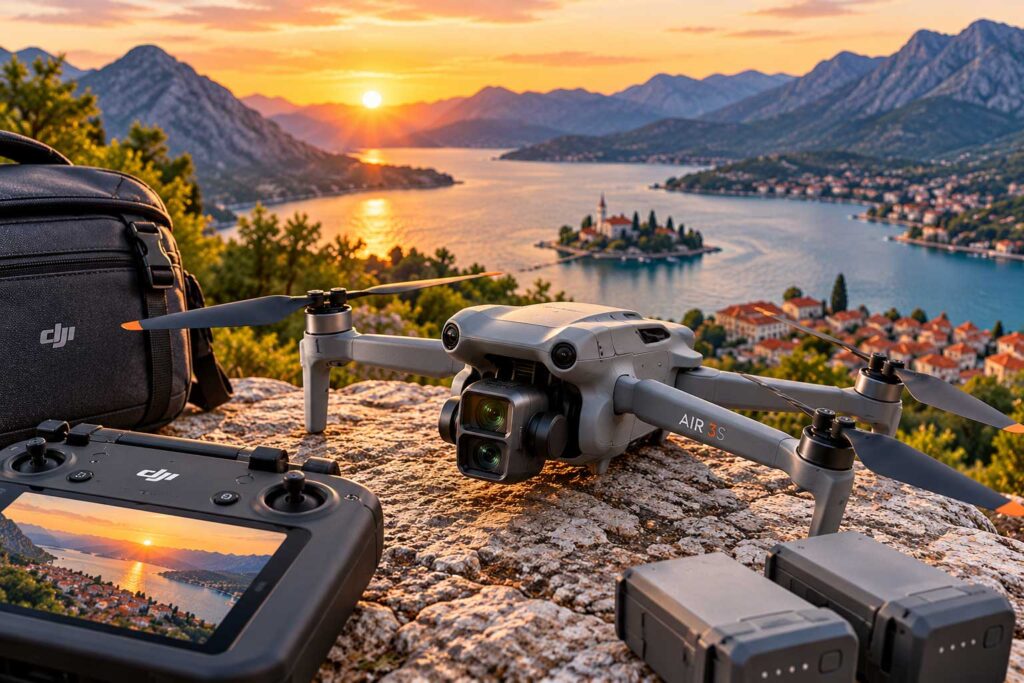
2. DJI Air 3S – Best Premium Travel Drone for Photography & Video
The DJI Air 3S is aimed at travelers who are willing to carry a larger drone in exchange for better camera flexibility and stronger overall flight performance. At 724 grams, it’s considerably heavier than the Mini 4 Pro, but that extra size comes with a dual-camera system, longer manufacturer-rated flight time, and capabilities geared toward more serious photography and video.
The biggest attraction is its dual-camera system. The main camera uses a 1-inch CMOS sensor, while the second camera provides a 70mm-equivalent medium telephoto perspective. Having two focal lengths lets you capture both wide landscapes and tighter compositions without having to move the drone significantly closer to your subject.
That flexibility can be especially useful while traveling. A wide view works well for coastlines, mountain ranges, and cityscapes, while the medium telephoto camera can isolate architectural details or create more compressed landscape compositions.
The Air 3S also offers omnidirectional obstacle sensing and a manufacturer-rated maximum flight time of up to 45 minutes under specified test conditions. It’s not nearly as effortless to pack as a sub-250 g drone, but for travelers who put camera capability ahead of minimum weight, the trade-off may be worthwhile.
Why It Stands Out
- Dual-camera system with wide and medium telephoto perspectives
- 1-inch CMOS sensor on the main camera
- Up to 4K/120fps video
- Up to 45 minutes of manufacturer-rated flight time
- Omnidirectional obstacle sensing
- Stronger flight performance than many ultra-light drones
- Intelligent tracking and automated shooting features
- Foldable design
Pros and Cons
| Pros | Cons |
|---|---|
| ✓ Dual cameras provide much more framing flexibility | ✗ At 724 g, it’s substantially heavier than sub-250 g drones |
| ✓ Large 1-inch sensor on the main camera | ✗ Takes up more space in a travel bag |
| ✓ Strong photo and video capabilities | ✗ More expensive than beginner and lightweight models |
| ✓ Up to 45 minutes of rated flight time | ✗ Registration and operating requirements may be more involved depending on your destination |
| ✓ Omnidirectional obstacle sensing | |
| ✓ Better suited to demanding conditions than many ultra-light drones | |
| ✓ Useful option for serious photographers and video creators |
DJI Air 3S Specifications
| Feature | Details |
|---|---|
| Camera System | Dual camera |
| Main Camera | 1-inch CMOS |
| Medium Tele Camera | 1/1.3-inch CMOS |
| Video | Up to 4K/120fps |
| Weight | 724 g |
| Max Flight Time* | Up to 45 minutes |
| Obstacle Sensing | Omnidirectional |
| Foldable | Yes |
*Flight time is a manufacturer-rated maximum measured under specified test conditions. Actual flight time varies with wind, temperature, flight speed, battery condition, and other factors.
Best For
The DJI Air 3S makes the most sense for travelers who care more about camera versatility and flight performance than carrying the lightest possible drone.
It’s particularly well suited to landscape photography, cinematic travel videos, road trips, content creation, and trips where you’re already carrying dedicated camera equipment.
Bottom Line
The DJI Air 3S sits between DJI’s ultra-light travel drones and its larger professional models. Its dual cameras give photographers more compositional freedom, while the larger main sensor and longer rated flight time make it better suited to travelers who take aerial photography seriously.
The trade-off is straightforward: it’s heavier, more expensive, and less convenient to carry than the Mini 4 Pro. If keeping your bag light is the priority, the Mini makes more sense. If image quality and having two useful focal lengths matter more, the Air 3S offers a significant step up in capability.
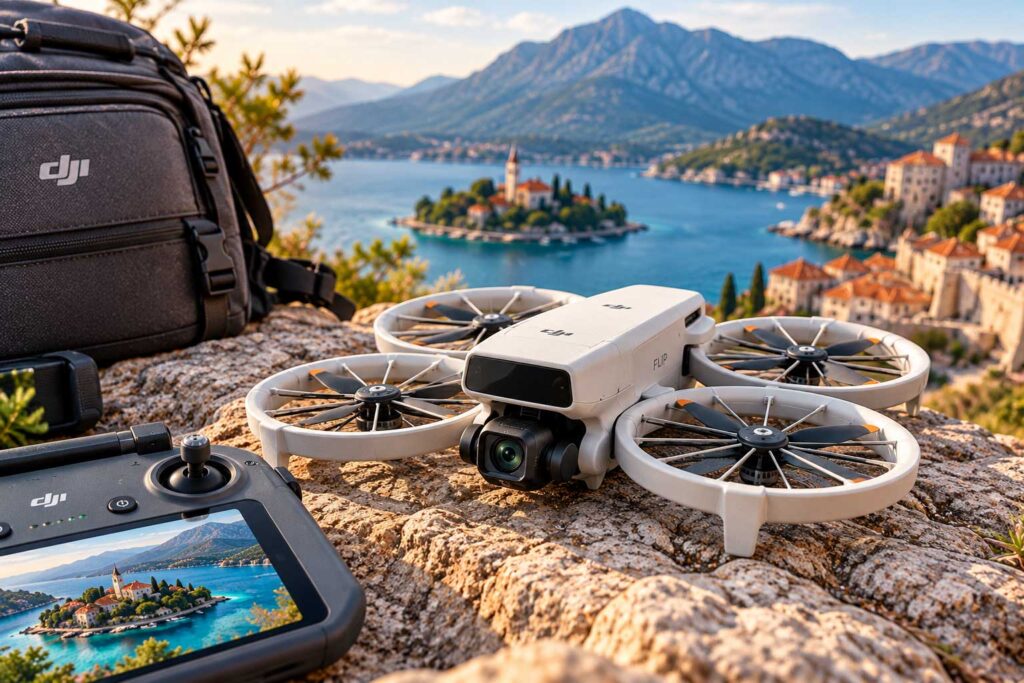
3. DJI Flip – Best Travel Drone for Beginners
The DJI Flip is an interesting option for travelers buying their first serious camera drone. It weighs less than 249 grams, folds down for travel, and combines a capable camera with automated shooting modes that can make capturing travel footage much less intimidating for a new pilot.
Its most distinctive feature is the full-coverage propeller guard design. Unlike the exposed propellers found on most traditional camera drones, the Flip surrounds its propellers with lightweight guards. This can provide additional protection against accidental propeller contact, although it doesn’t replace careful flying or the need to follow local drone regulations.
The Flip can also take off from your hand and offers automated shooting modes for quickly capturing clips without setting up a complicated flight. That makes it particularly appealing for solo travelers and beginners who want to record themselves while hiking, sightseeing, or exploring a destination.
Its camera uses a 1/1.3-inch sensor and can capture 4K video, while a three-axis mechanical gimbal keeps footage stable. It’s more capable than a simple selfie drone but remains considerably easier to carry than larger photography-focused models.
Why It Stands Out
- Weighs under 249 g
- Full-coverage propeller guards
- 1/1.3-inch camera sensor
- 4K video recording
- Three-axis mechanical gimbal
- Palm takeoff
- Automated shooting modes
- Foldable travel-friendly design
- Up to 31 minutes of manufacturer-rated flight time
Pros and Cons
| Pros | Cons |
|---|---|
| ✓ Lightweight at under 249 g | ✗ Less camera flexibility than dual-camera drones |
| ✓ Full-coverage propeller guards add protection against accidental contact | ✗ Larger folded footprint than some Mini-series drones |
| ✓ Easy automated shooting modes | ✗ Not the strongest choice for demanding wind conditions |
| ✓ Palm takeoff makes quick shots convenient | ✗ Advanced photographers may prefer more capable models |
| ✓ Three-axis gimbal provides stabilized footage | |
| ✓ 4K video from a 1/1.3-inch sensor | |
| ✓ Beginner-friendly without being limited to basic footage |
DJI Flip Specifications
| Feature | Details |
|---|---|
| Camera Sensor | 1/1.3-inch CMOS |
| Video | Up to 4K |
| Photo Resolution | Up to 48 MP |
| Weight | Under 249 g |
| Max Flight Time* | Up to 31 minutes |
| Gimbal | 3-axis mechanical |
| Propeller Guards | Full coverage |
| Palm Takeoff | Yes |
| Foldable | Yes |
*Flight time is a manufacturer-rated maximum measured under specified test conditions. Actual flight time can be shorter depending on wind, temperature, flight speed, battery condition, and other factors.
Best For
The DJI Flip is particularly well suited to:
- First-time drone owners
- Casual vacation photography
- Solo travelers
- Weekend trips
- Road trips
- Hiking and outdoor adventures
- Social media and travel content
- Travelers who value simple automated shooting
Bottom Line
The DJI Flip makes the most sense for travelers who want something more capable than a basic selfie drone without immediately moving into a more complicated or expensive camera-drone setup.
Its combination of a sub-249 g body, full-coverage propeller guards, palm takeoff, automated shooting modes, and a stabilized 4K camera makes it particularly approachable for beginners.
More experienced photographers may prefer the additional camera and flight capabilities of the Mini 4 Pro or Air 3S. But for a first travel drone where simplicity, portability, and easy shooting are the priorities, the Flip is a compelling option.
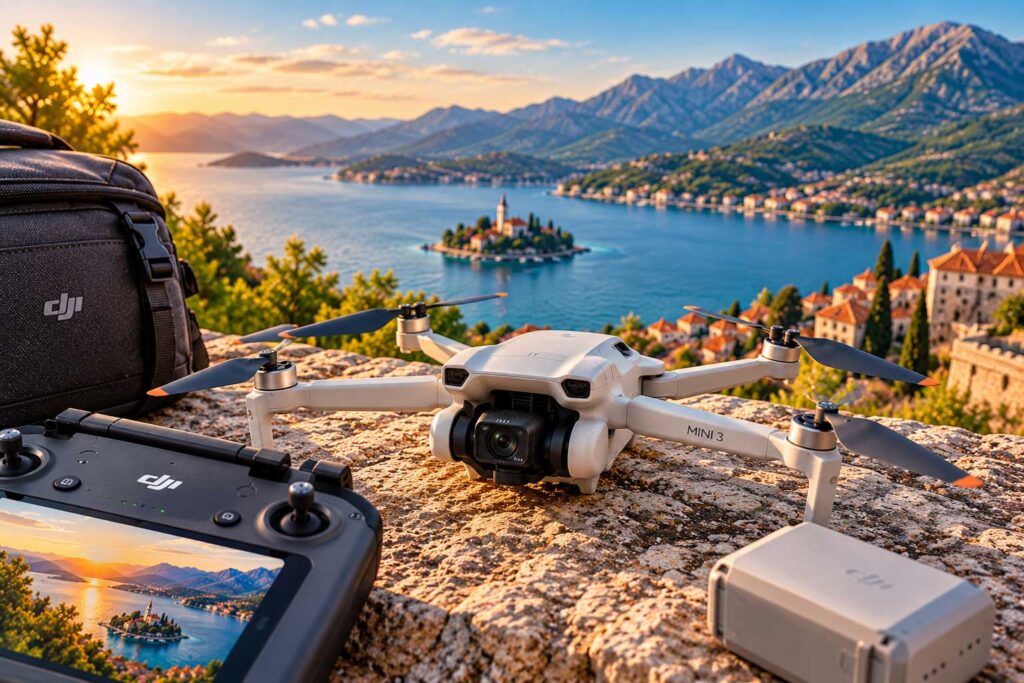
4. DJI Mini 3 – Best Value Travel Drone
The DJI Mini 3 is a good fit for travelers who want the portability and camera quality of DJI’s Mini series without paying for all the advanced features found on the Mini 4 Pro.
Weighing less than 249 grams with the standard battery, it folds down small enough to fit easily into a backpack or camera bag. That’s particularly useful on trips where you’re already carrying a phone, camera, chargers, and other travel gear.
The Mini 3 uses a 1/1.3-inch CMOS sensor and can record 4K HDR video. Its camera is mounted on a three-axis mechanical gimbal, which helps keep footage smooth while the drone is moving. The camera can also rotate for vertical shooting, a useful feature if you regularly create content for Instagram, TikTok, or other mobile-first platforms.
Where the Mini 3 differs most from DJI’s more advanced compact drones is in its safety and tracking technology. It doesn’t offer the omnidirectional obstacle sensing of the Mini 4 Pro, so pilots need to pay closer attention to their surroundings.
For travelers who don’t need those extra features, however, the simpler Mini 3 can offer a very appealing balance of camera capability, low weight, battery life, and price.
Why It Stands Out
- Under 249 g with the standard battery
- 1/1.3-inch CMOS camera sensor
- 4K HDR video
- Three-axis mechanical gimbal
- True Vertical Shooting
- Up to 38 minutes of manufacturer-rated flight time with the standard battery
- Compact foldable body
- Straightforward controls for newer pilots
Pros and Cons
| Pros | Cons |
|---|---|
| ✓ Lightweight at under 249 g with the standard battery | ✗ No omnidirectional obstacle sensing |
| ✓ 1/1.3-inch sensor provides good image quality for its size | ✗ Fewer tracking and intelligent features than the Mini 4 Pro |
| ✓ Records 4K HDR video | ✗ Requires more pilot awareness around obstacles |
| ✓ Three-axis mechanical gimbal | ✗ Larger drones may handle demanding conditions better |
| ✓ True Vertical Shooting is useful for social media | |
| ✓ Up to 38 minutes of rated flight time | |
| ✓ Usually less expensive than DJI’s higher-end Mini models |
DJI Mini 3 Specifications
| Feature | Details |
|---|---|
| Camera Sensor | 1/1.3-inch CMOS |
| Video | Up to 4K HDR |
| Photos | 12 MP; up to 48 MP mode |
| Weight | Under 249 g with standard battery |
| Max Flight Time* | Up to 38 minutes |
| Gimbal | 3-axis mechanical |
| Downward Vision System | Yes |
| Vertical Shooting | Yes |
| Foldable | Yes |
*Flight time is a manufacturer-rated maximum under specified test conditions using the standard Intelligent Flight Battery. Actual flight time varies with wind, temperature, flight speed, battery condition, and other factors.
Best For
The DJI Mini 3 is particularly well suited to:
- Budget-conscious travelers
- First-time camera-drone owners
- Vacation photography
- Backpacking
- Road trips
- Hiking
- Travel blogging
- Vertical social media content
Bottom Line
The DJI Mini 3 makes the most sense for travelers who want a capable compact camera drone but don’t necessarily need sophisticated obstacle sensing or advanced subject tracking.
You still get a lightweight folding body, a 1/1.3-inch camera sensor, stabilized 4K HDR video, vertical shooting, and strong manufacturer-rated battery life.
The Mini 4 Pro offers considerably more technology, but not every traveler needs it. If keeping the price lower while retaining the core camera and portability advantages of DJI’s Mini lineup matters more, the Mini 3 remains a practical alternative.
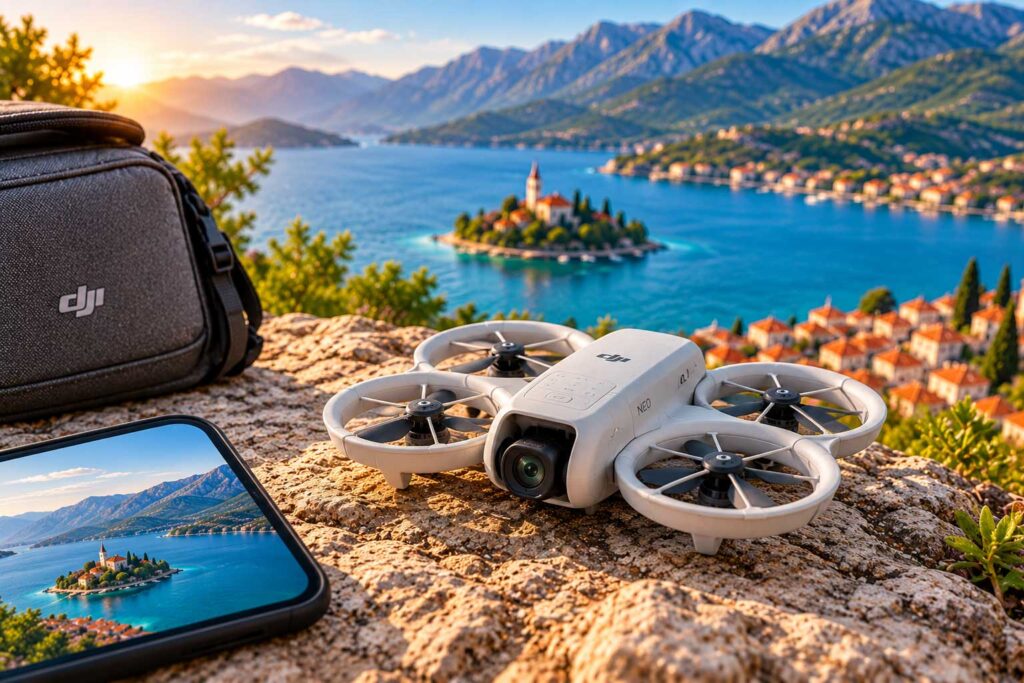
5. DJI Neo – Best Ultra-Light Travel Drone
At just 135 grams, the DJI Neo is built around portability and quick, simple filming rather than the long-range aerial photography experience you get from a traditional camera drone.
Its small size is the main attraction for travelers. The Neo can fit into a daypack without taking up much room, making it particularly convenient for hiking, sightseeing, weekend trips, and vacations where you don’t want to carry a dedicated drone bag.
It can also take off from and land on your palm, and several automated shooting modes let the drone capture short clips with minimal setup. That can be especially useful for solo travelers who want footage of themselves walking, hiking, cycling, or exploring without having another person behind the camera.
The Neo records 4K video and uses electronic stabilization to help smooth the footage. However, its tiny size comes with compromises. Flight time is much shorter than you’ll get from models such as the Mini 3 or Mini 4 Pro, and its lightweight body means you’ll need to pay closer attention to wind conditions.
Think of the Neo less as a replacement for a full camera drone and more as an ultra-portable flying camera for quick travel clips.
Why It Stands Out
- Extremely light at 135 g
- Compact enough for very light travel setups
- Palm takeoff and landing
- Automated shooting modes
- 4K video recording
- Electronic image stabilization
- Can be used without a traditional remote for certain automated flights
- Useful for solo travelers and quick travel videos
Pros and Cons
| Pros | Cons |
|---|---|
| ✓ Extremely lightweight at 135 g | ✗ Much shorter flight time than larger travel drones |
| ✓ Very easy to carry in a small bag | ✗ Very low weight requires more attention to wind conditions |
| ✓ Palm takeoff and landing | ✗ Camera system is more limited than DJI’s Mini models |
| ✓ Automated shooting modes simplify quick clips | ✗ Electronic stabilization rather than a traditional 3-axis camera gimbal |
| ✓ Records 4K video | ✗ Not the best choice for serious aerial photography |
| ✓ Useful for filming yourself while traveling | |
| ✓ Doesn’t require carrying a controller for every type of flight |
DJI Neo Specifications
| Feature | Details |
|---|---|
| Video | Up to 4K |
| Weight | 135 g |
| Max Flight Time* | Up to 18 minutes |
| Stabilization | Electronic |
| Palm Takeoff/Landing | Yes |
| Automated Shooting Modes | Yes |
| Traditional Controller Required | Not for all flight modes |
| Foldable | No |
*Flight time is a manufacturer-rated maximum measured under specified test conditions. Actual flight time can be shorter depending on wind, temperature, flight behavior, battery condition, and other factors.
Best For
The DJI Neo makes the most sense for:
- Solo travelers
- Travelers packing very light
- Hiking and walking trips
- Weekend getaways
- Casual travel videos
- Social media creators
- First-time drone users
- Anyone who wants quick automated clips without carrying a full drone kit
Bottom Line
The DJI Neo fills a different role from traditional travel drones such as the Mini 3 and Mini 4 Pro. Its biggest advantages are its 135 g weight, palm launch, and ability to capture automated clips with very little setup.
The trade-offs are shorter flight time, less sophisticated camera hardware, and less capability in challenging conditions.
For travelers primarily interested in sweeping aerial landscapes and more advanced photography, a DJI Mini model is the better fit. But if your priority is having a tiny flying camera that you can pull out quickly to capture yourself and your surroundings, the Neo is an interesting option.
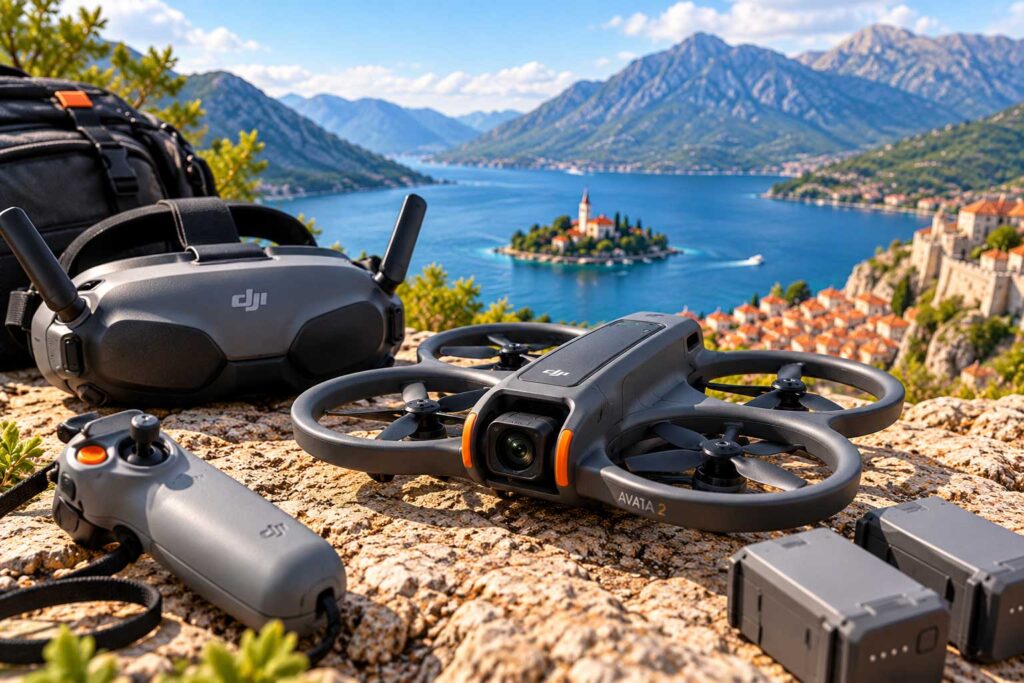
6. DJI Avata 2 – Best FPV Travel Drone for Adventure Seekers
The DJI Avata 2 offers a very different experience from the conventional camera drones on this list. Instead of primarily hovering above a landscape for photos and sweeping aerial shots, it’s designed for first-person-view (FPV) flying, putting the pilot much closer to the feeling of actually moving through the scene.
Using compatible DJI goggles, you see a live view from the drone’s camera while flying. This makes it possible to create fast, immersive sequences through landscapes and around natural features that look very different from footage captured by a traditional camera drone.
That style makes the Avata 2 particularly interesting for adventure travel. Mountain trails, coastlines, forests, abandoned structures where flying is permitted, and other dramatic environments can all provide opportunities for creative FPV footage.
The drone has integrated propeller guards, which provide additional protection against accidental propeller contact. It also records up to 4K video and uses electronic stabilization to smooth footage during fast or aggressive movements.
There are trade-offs, though. The goggles and controller add more equipment to your travel bag, flight time is shorter than with many conventional camera drones, and FPV flying takes more practice to master.
Why It Stands Out
- Immersive first-person-view flying
- Records up to 4K/100fps video
- Wide field of view for dynamic footage
- Integrated propeller guards
- RockSteady and HorizonSteady stabilization
- Compact cinewhoop-style design
- Up to 23 minutes of manufacturer-rated flight time
- Designed specifically for dynamic, close-to-the-action video
Pros and Cons
| Pros | Cons |
|---|---|
| ✓ Creates footage that looks very different from a conventional camera drone | ✗ FPV flying has a steeper learning curve |
| ✓ Up to 4K/100fps video | ✗ Goggles and controller add extra equipment to your bag |
| ✓ Integrated propeller guards | ✗ Shorter flight time than many traditional camera drones |
| ✓ Electronic stabilization helps smooth fast footage | ✗ Less focused on still photography |
| ✓ Wide-angle perspective works well for immersive sequences | ✗ Does not offer the omnidirectional obstacle sensing found on some DJI camera drones |
| ✓ Compact compared with many custom FPV setups | |
| ✓ Particularly suited to action and adventure footage |
DJI Avata 2 Specifications
| Feature | Details |
|---|---|
| Camera Sensor | 1/1.3-inch CMOS |
| Video | Up to 4K/100fps |
| Weight | Approx. 377 g |
| Max Flight Time* | Up to 23 minutes |
| Stabilization | RockSteady & HorizonSteady |
| Propeller Guards | Integrated |
| FPV Goggles | Supported |
| Foldable | No |
*Flight time is a manufacturer-rated maximum measured under specified test conditions. Actual flight time varies with speed, wind, temperature, flight style, battery condition, and other factors.
Best For
The DJI Avata 2 is particularly well suited to:
- Adventure travelers
- FPV enthusiasts
- Mountain and coastal footage
- Action-sports content
- Mountain biking videos
- Skiing and snowboarding footage
- Fast cinematic travel sequences
- Creators who want something different from traditional aerial shots
Bottom Line
The DJI Avata 2 isn’t a direct replacement for a Mini 4 Pro or Air 3S. It’s built for a different type of travel footage.
Traditional camera drones are generally better when you want slow landscape shots, aerial photography, longer flight times, and straightforward operation. The Avata 2 becomes more interesting when you want the camera to move through a landscape rather than simply film it from above.
For travelers willing to carry the goggles and spend time learning FPV flight, the Avata 2 can add a completely different visual style to travel videos. If photography and simple point-to-point flying are your priorities, however, one of the conventional camera drones on this list will probably make more sense.
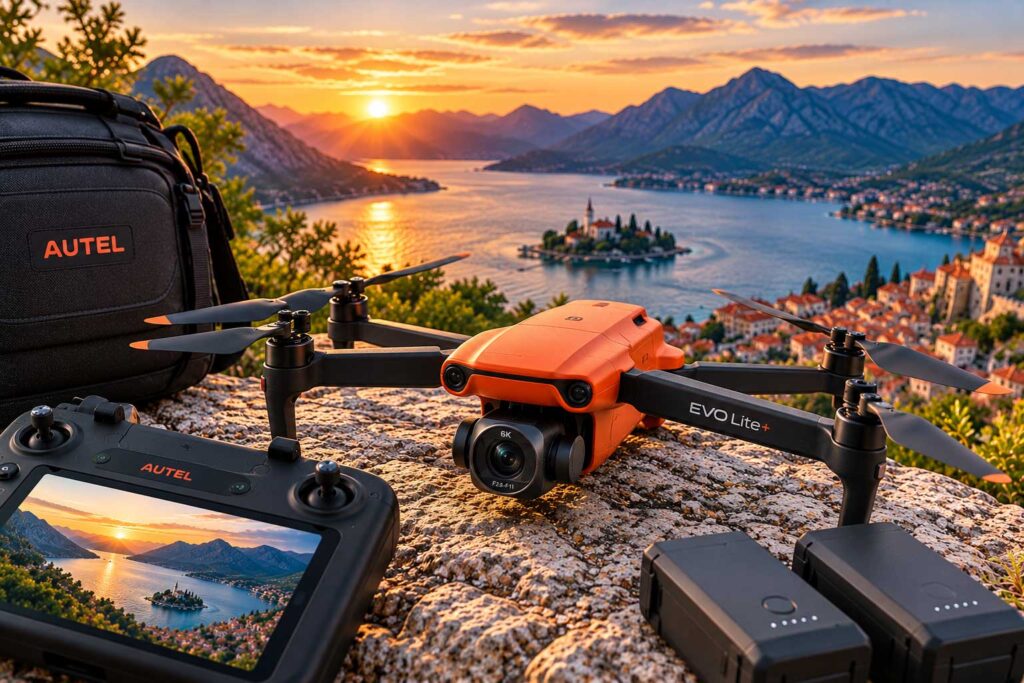
7. Autel EVO Lite+ – Best Travel Drone for Low-Light Photography
The Autel EVO Lite+ is an older drone compared with several of the newer models in this guide, but its camera hardware still gives photographers a reason to consider it—particularly if you find one at an attractive price.
Its biggest advantage is the 1-inch CMOS sensor paired with an adjustable f/2.8–f/11 aperture. That combination gives photographers more control over exposure than many smaller travel drones and can be particularly useful around sunrise, sunset, and other situations where the light changes quickly.
The EVO Lite+ can record video at up to 6K and capture 20 MP still photos. For travelers primarily interested in landscapes, coastlines, mountains, and cityscapes, the larger sensor remains one of the most interesting features of this model.
The trade-off is portability. At around 835 grams, the EVO Lite+ is much heavier than a Mini-series drone and requires considerably more room in your bag. It’s better suited to road trips and photography-focused vacations than trips where you’re trying to travel with the smallest possible setup.
Availability is another consideration. Because the EVO Lite+ is no longer one of the newest drones on the market, pricing and stock can vary. That makes it worth comparing against newer alternatives before buying.
Why It Stands Out
- Large 1-inch CMOS sensor
- Adjustable f/2.8–f/11 aperture
- Records video at up to 6K
- 20 MP still photography
- Up to 40 minutes of manufacturer-rated flight time
- Three-way obstacle sensing
- Foldable design
- Interesting option for photographers who prefer an alternative to DJI
Pros and Cons
| Pros | Cons |
|---|---|
| ✓ 1-inch sensor is well suited to photography | ✗ Much heavier than sub-250 g travel drones |
| ✓ Adjustable aperture provides additional exposure control | ✗ Older model compared with many drones in this guide |
| ✓ Records video at up to 6K | ✗ Availability and pricing can vary |
| ✓ 20 MP still photography | ✗ Requires more room in a travel bag |
| ✓ Up to 40 minutes of rated flight time | ✗ Obstacle sensing is less comprehensive than newer omnidirectional systems |
| ✓ Foldable despite its larger size | ✗ Newer competitors may offer more advanced tracking and safety features |
Autel EVO Lite+ Specifications
| Feature | Details |
|---|---|
| Camera Sensor | 1-inch CMOS |
| Video | Up to 6K |
| Photo Resolution | 20 MP |
| Aperture | Adjustable f/2.8–f/11 |
| Weight | Approx. 835 g |
| Max Flight Time* | Up to 40 minutes |
| Obstacle Sensing | Three-way |
| Foldable | Yes |
*Flight time is a manufacturer-rated maximum measured under specified test conditions. Actual flight time varies with wind, temperature, speed, battery condition, and other factors.
Best For
The Autel EVO Lite+ is most interesting for:
- Landscape photographers
- Sunrise and sunset photography
- Coastal and mountain trips
- Road trips
- Travel photographers who value a larger sensor
- Travelers who don’t mind carrying a heavier drone
- Buyers who find it discounted or available at a competitive price
Bottom Line
The Autel EVO Lite+ still has one feature that makes it relevant: its combination of a 1-inch sensor, adjustable aperture, and 6K video capability.
That doesn’t automatically make it a better purchase than newer drones. It’s heavier, its obstacle-sensing system isn’t as comprehensive as newer designs, and availability may be inconsistent.
But if photography is your priority and you find the EVO Lite+ at a good price, its larger sensor and adjustable aperture can still make it an interesting travel drone—especially for landscapes and shooting around sunrise or sunset.
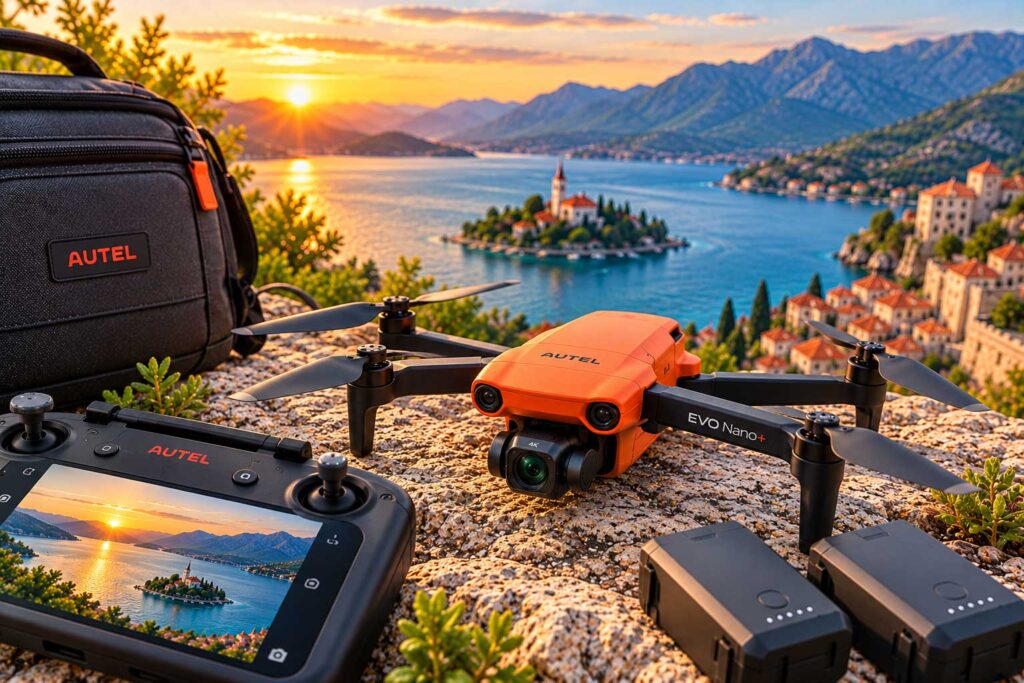
8. Autel EVO Nano+ – Best Compact Alternative to DJI
The Autel EVO Nano+ is worth considering if you want a lightweight travel drone but would rather look beyond DJI’s Mini lineup. At 249 grams, it’s easy to fit into a backpack or camera bag, while its foldable design keeps the overall travel setup relatively compact.
One of the Nano+’s more interesting features is its camera. It uses a 1/1.28-inch CMOS sensor with a bright f/1.9 aperture, giving it capable hardware for such a small aircraft. It can capture 50 MP photos and record 4K video, making it suitable for landscapes, coastlines, cities, and general vacation photography.
The Nano+ also includes three-way obstacle sensing, covering the forward, backward, and downward directions. That’s useful on a compact drone, although it shouldn’t be confused with the more comprehensive omnidirectional sensing available on newer premium models.
Its biggest consideration in 2026 is age. The Nano+ has been available for several years, and newer drones now offer more advanced tracking, safety features, and software. Availability and pricing can also vary, so it makes sense to compare the Nano+ with current alternatives before buying.
If you find one at a competitive price, however, the combination of 249 g weight, a relatively large sensor, bright lens, and 4K video still gives it some appeal as a compact travel drone.
Why It Stands Out
- Lightweight 249 g design
- 1/1.28-inch CMOS sensor
- Bright f/1.9 aperture
- 50 MP photo capability
- 4K video recording
- Three-way obstacle sensing
- Three-axis mechanical gimbal
- Foldable body
- Alternative to DJI’s compact travel drones
Pros and Cons
| Pros | Cons |
|---|---|
| ✓ Lightweight at 249 g | ✗ Older model compared with many current travel drones |
| ✓ Relatively large 1/1.28-inch sensor for its size | ✗ Availability and pricing can vary |
| ✓ Bright f/1.9 aperture | ✗ Three-way sensing isn’t as comprehensive as omnidirectional systems |
| ✓ Captures 50 MP photos | ✗ Smaller accessory ecosystem than DJI |
| ✓ Records 4K video | ✗ Newer competitors offer more advanced tracking and automated features |
| ✓ Three-axis mechanical gimbal | |
| ✓ Compact, foldable design |
Autel EVO Nano+ Specifications
| Feature | Details |
|---|---|
| Camera Sensor | 1/1.28-inch CMOS |
| Video | Up to 4K |
| Photo Resolution | Up to 50 MP |
| Aperture | f/1.9 |
| Weight | 249 g |
| Max Flight Time* | Up to 28 minutes |
| Gimbal | 3-axis mechanical |
| Obstacle Sensing | Forward, backward & downward |
| Foldable | Yes |
*Flight time is a manufacturer-rated maximum measured under specified test conditions. Actual flight time varies with wind, temperature, flight speed, battery condition, and other factors.
Best For
The Autel EVO Nano+ is most interesting for:
- Travelers looking for an alternative to DJI
- Backpacking and lightweight travel
- Landscape photography
- Weekend trips
- Road trips
- Travelers who value a bright camera lens
- Buyers who find it at a competitive price
Bottom Line
The Autel EVO Nano+ remains an interesting compact drone because it combines a 249 g body with a 1/1.28-inch sensor, f/1.9 aperture, 50 MP photo capability, and three-axis stabilization.
Its age is the main reason to compare carefully before buying. Newer drones offer more sophisticated safety and tracking features, and Autel’s accessory ecosystem isn’t as extensive as DJI’s.
But if you’re specifically looking for a compact non-DJI travel drone and find the Nano+ at a good price, its camera hardware and low weight still make it worth considering.
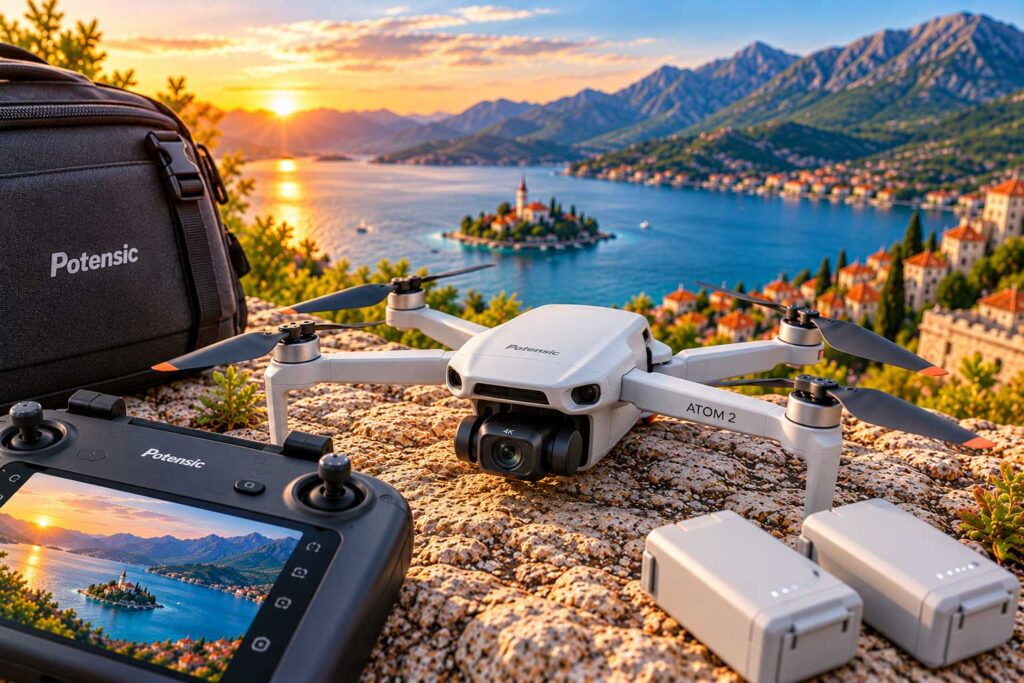
9. Potensic ATOM 2 – Best Budget Travel Drone
The Potensic ATOM 2 is aimed at travelers who want many of the features of a modern camera drone without moving into premium pricing. Its combination of a sub-249 g body, three-axis gimbal, 4K video, GPS-assisted flight, and automated shooting modes makes it particularly interesting for beginners and budget-conscious travelers.
Portability is one of its biggest advantages. The ATOM 2 folds down into a compact package and weighs less than 249 grams, making it easy to carry in a backpack or camera bag on vacations, road trips, hikes, and other trips where luggage space matters.
The camera is also more capable than you might expect from an entry-level travel drone. It uses a 1/2-inch Sony CMOS sensor, can record 4K video, and includes a three-axis mechanical gimbal to keep footage stable while the aircraft is moving.
Potensic also includes automated shooting and tracking features that can help newer pilots create more interesting footage without manually controlling every camera movement.
The main compromise is safety technology. Unlike more expensive drones such as the DJI Mini 4 Pro, the ATOM 2 doesn’t provide the same comprehensive obstacle-sensing system. That means pilots need to be particularly aware of trees, buildings, power lines, and other obstacles while flying.
Why It Stands Out
- Weighs under 249 g
- 1/2-inch Sony CMOS sensor
- 4K video recording
- Three-axis mechanical gimbal
- GPS-assisted positioning
- Intelligent shooting and tracking modes
- Compact foldable design
- Designed with beginners in mind
- Lower price than many premium travel drones
Pros and Cons
| Pros | Cons |
|---|---|
| ✓ Lightweight at under 249 g | ✗ Lacks the comprehensive obstacle sensing of premium models |
| ✓ Three-axis mechanical gimbal | ✗ Camera hardware is less advanced than larger premium drones |
| ✓ Records 4K video | ✗ Smaller accessory ecosystem than DJI |
| ✓ GPS-assisted flight | |
| ✓ Compact folding design | |
| ✓ Automated shooting and tracking features | |
| ✓ Attractive option for first-time camera-drone buyers |
Potensic ATOM 2 Specifications
| Feature | Details |
|---|---|
| Camera Sensor | 1/2-inch Sony CMOS |
| Video | Up to 4K |
| Weight | Under 249 g |
| Gimbal | 3-axis mechanical |
| Positioning | GNSS/GPS-assisted |
| Intelligent Shooting Modes | Yes |
| Foldable | Yes |
Battery life and available features can vary by flight mode, firmware, battery configuration, and operating conditions, so check the current manufacturer’s specifications for the version you’re considering.
Best For
The Potensic ATOM 2 is particularly well suited to:
- Budget-conscious travelers
- First-time camera-drone owners
- Weekend trips
- Road trips
- Hiking and camping
- Casual aerial photography
- Social media content
- Travelers who want a lightweight DJI alternative
Bottom Line
The Potensic ATOM 2 is worth considering if you don’t need every premium feature but still want the basics of a proper camera drone: 4K video, a three-axis gimbal, GPS-assisted flight, automated shooting features, and a body weighing less than 249 grams.
You give up some of the obstacle-sensing technology and ecosystem advantages available on more expensive models, but that may be a reasonable trade-off if price is a major consideration.
For someone buying a first travel drone—or simply looking for a lightweight option without DJI-level pricing—the ATOM 2 is one of the more interesting models to compare.
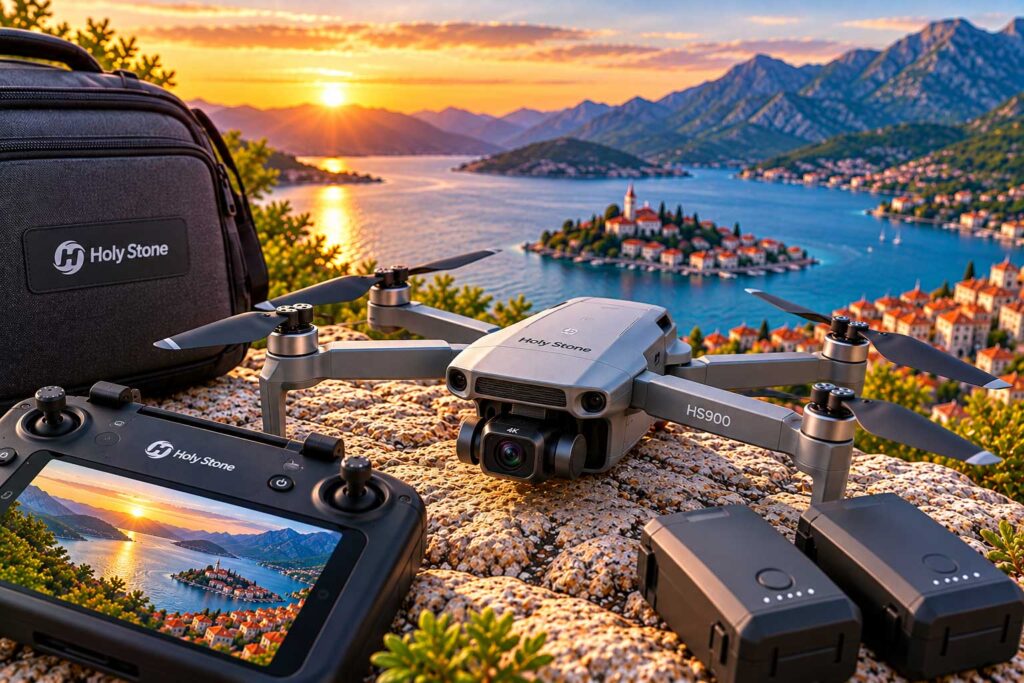
10. Holy Stone HS900 – Best Affordable GPS Travel Drone
The Holy Stone HS900 is designed for travelers who want the features of a proper GPS camera drone without moving into the higher price range of premium models. Its combination of a sub-249 g body, 4K camera, three-axis gimbal, GPS positioning, and Return to Home makes it particularly interesting for beginners.
At under 249 grams, the HS900 is light enough to carry comfortably on vacations, road trips, hikes, and weekend getaways. Its foldable design also means it doesn’t take up much room in a backpack or camera bag.
For aerial photography, the HS900 records 4K video and uses a three-axis mechanical gimbal to stabilize the camera. That’s an important feature at this price level because mechanical stabilization can produce noticeably smoother footage than drones that rely primarily on electronic stabilization.
GPS-assisted positioning helps the drone maintain its location while hovering and also supports features such as Return to Home. These features can make flying less intimidating for someone moving from a basic toy drone to a more capable camera drone.
There are still compromises compared with more expensive models. Most importantly, the HS900 doesn’t offer the sophisticated obstacle-sensing systems found on drones such as the DJI Mini 4 Pro. Pilots therefore need to pay close attention to trees, buildings, power lines, and other obstacles.
Why It Stands Out
- Weighs under 249 g
- Records 4K video
- Three-axis mechanical gimbal
- GPS-assisted positioning
- Return to Home
- Foldable travel-friendly design
- Automated flight features
- Accessible option for first-time camera-drone owners
Pros and Cons
| Pros | Cons |
|---|---|
| ✓ Lightweight at under 249 g | ✗ No comprehensive obstacle-sensing system |
| ✓ 4K video recording | ✗ Camera system isn’t as advanced as premium travel drones |
| ✓ Three-axis mechanical gimbal | ✗ Smaller accessory and software ecosystem than major premium brands |
| ✓ GPS-assisted hovering and navigation | ✗ Fewer advanced tracking and cinematic features |
| ✓ Return to Home functionality | |
| ✓ Foldable and easy to pack | |
| ✓ Approachable option for beginners |
Holy Stone HS900 Specifications
| Feature | Details |
|---|---|
| Video | Up to 4K |
| Weight | Under 249 g |
| Gimbal | 3-axis mechanical |
| Positioning | GPS-assisted |
| Return to Home | Yes |
| Intelligent Flight Features | Yes |
| Foldable | Yes |
Flight time and available features can vary with battery configuration, firmware, flight conditions, and operating mode. Check the current manufacturer’s specifications for the version you’re considering.
Best For
The Holy Stone HS900 is particularly well suited to:
- Beginner drone pilots
- Budget-conscious travelers
- Family vacations
- Weekend trips
- Road trips
- Casual aerial photography
- Travelers who want GPS and Return to Home
- First-time buyers moving beyond basic toy drones
Bottom Line
The Holy Stone HS900 offers a useful combination of 4K video, a three-axis gimbal, GPS-assisted flight, Return to Home, and a sub-249 g design without requiring the budget of a premium camera drone.
It doesn’t provide the advanced obstacle sensing, tracking technology, or camera hardware found on more expensive models, so those differences are worth considering before buying.
But for travelers who primarily want an affordable, lightweight GPS drone for casual aerial photography, the HS900 offers many of the features that matter most without adding much weight to a travel bag.
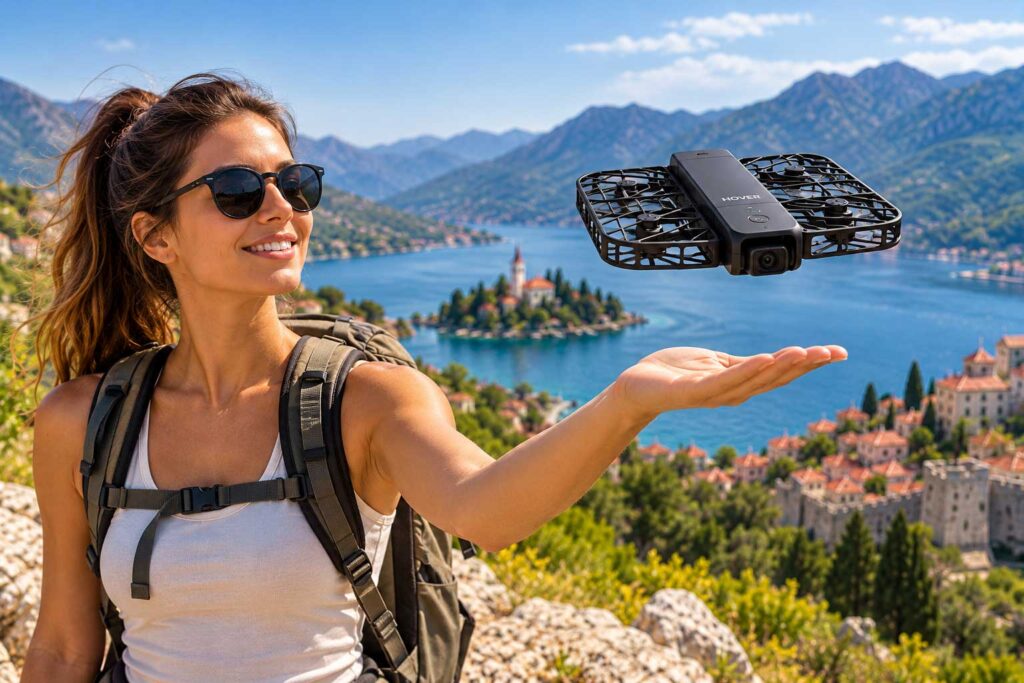
11. HOVERAir X1 PRO – Best Hands-Free Travel Drone
The HOVERAir X1 PRO is quite different from most of the drones in this guide. Instead of being designed primarily for traditional aerial photography, it’s essentially a self-flying camera built to follow and film you automatically.
That makes it particularly useful for solo travelers. You can launch it from your palm, choose an automated flight mode, and let the drone handle much of the flying while you walk, hike, cycle, or explore.
At around 192 grams, it’s also one of the lightest options in this guide. The drone folds down into a remarkably compact package, so it’s easy to slip into a backpack or small travel bag without carrying a conventional drone case.
The propellers are surrounded by protective cages, which helps reduce the chance of accidental propeller contact. That’s especially useful for a drone designed around close-range tracking and palm takeoffs and landings, although pilots still need to follow normal safety precautions.
The X1 PRO records up to 4K video at 60fps and offers automated flight modes designed to capture different perspectives without requiring the pilot to manually control every movement.
Its limitations become clearer when you compare it with a conventional camera drone. This isn’t the model to choose primarily for long-distance flights, high-altitude landscape photography, or manually composing aerial photographs from far away. Its strength is capturing you and your surroundings while you’re actually doing something.
Why It Stands Out
- Designed for hands-free self-filming
- Automatic subject tracking
- Palm takeoff and landing
- Approximately 192 g
- Foldable, pocket-friendly design
- Up to 4K/60fps video
- Enclosed propeller design
- Multiple automated flight modes
- Particularly useful for solo travelers and outdoor activities
Pros and Cons
| Pros | Cons |
|---|---|
| ✓ Excellent for hands-free self-filming | ✗ Shorter flight time than conventional camera drones |
| ✓ Extremely compact and lightweight | ✗ Not designed primarily for long-range aerial photography |
| ✓ Palm takeoff and landing | ✗ Less manual flight flexibility than a traditional camera drone |
| ✓ Automated tracking requires little piloting experience | ✗ Small size gives it different wind limitations than larger drones |
| ✓ Enclosed propellers help reduce accidental propeller contact | ✗ Not the best choice for photographers who want complete manual composition |
| ✓ Up to 4K/60fps video | |
| ✓ Foldable design takes up very little luggage space |
HOVERAir X1 PRO Specifications
| Feature | Details |
|---|---|
| Video | Up to 4K/60fps |
| Weight | Approx. 192 g |
| Max Flight Time* | Up to 16 minutes |
| Subject Tracking | Yes |
| Palm Takeoff & Landing | Yes |
| Navigation | Visual positioning and intelligent tracking |
| Propeller Protection | Fully enclosed |
| Foldable | Yes |
*Flight time is a manufacturer-rated maximum measured under specified test conditions. Actual flight time varies with wind, flight mode, speed, temperature, battery condition, and other factors.
Best For
The HOVERAir X1 PRO is particularly well suited to:
- Solo travelers
- Hikers
- Cyclists
- Backpackers
- Runners
- Outdoor adventures
- Travel vloggers
- Social media creators
- Travelers who want to film themselves without another person operating the camera
Bottom Line
The HOVERAir X1 PRO makes the most sense when you think of it as a flying personal camera rather than a traditional camera drone.
A DJI Mini 4 Pro or similar drone gives you more freedom to fly out over landscapes and manually compose aerial photographs. The X1 PRO takes a different approach: launch it, let it track you, capture the moment, and put it back in your bag.
For hiking, cycling, walking through scenic destinations, or traveling alone, that simplicity can be more useful than having a longer-range drone with dozens of manual controls.
If your main goal is capturing yourself as part of the adventure, the HOVERAir X1 PRO is one of the most distinctive options in this guide.
12. DJI Mavic 3 Pro – Best Professional Travel Drone
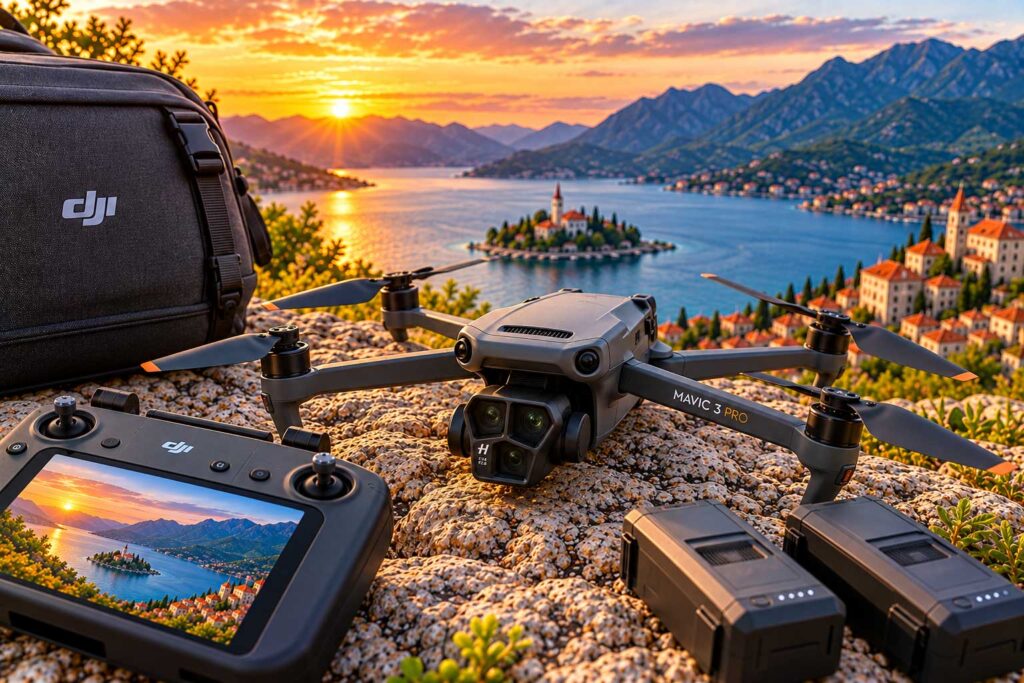
The DJI Mavic 3 Pro is aimed at photographers and filmmakers who care more about camera flexibility and image quality than traveling with the smallest possible drone.
At 958 grams, it’s considerably heavier than the Mini-series drones in this guide, so you’ll notice it in your camera bag. In return, you get something the smaller models can’t offer: a three-camera system with multiple focal lengths that lets you capture very different perspectives without moving the drone nearly as much.
The main camera uses a 4/3 CMOS Hasselblad sensor, making it particularly well suited to detailed landscape photography and higher-end video work. It’s joined by a medium tele camera and a longer telephoto camera, giving creators more flexibility when photographing mountains, coastlines, architecture, cities, and distant subjects.
That versatility can be especially useful while traveling. A wide landscape might call for the main camera, while the telephoto cameras can isolate distant details or visually compress layers of mountains and buildings.
The Mavic 3 Pro also includes omnidirectional obstacle sensing, intelligent flight features, a three-axis gimbal, and up to 43 minutes of manufacturer-rated flight time.
The obvious compromises are size, weight, and price. This isn’t a drone you’ll casually slip into a small daypack. It’s better suited to photography-focused trips where aerial footage is an important part of what you’re traveling to create.
Why It Stands Out
- Triple-camera system with three different focal-length options
- 4/3 CMOS Hasselblad main camera
- Medium tele camera
- Telephoto camera
- Records up to 5.1K video with the main camera
- Omnidirectional obstacle sensing
- Three-axis mechanical gimbal
- Up to 43 minutes of manufacturer-rated flight time
- Foldable design despite its larger size
Pros and Cons
| Pros | Cons |
|---|---|
| ✓ Three cameras provide far more framing flexibility than a single-camera drone | ✗ Much heavier than sub-250 g travel drones |
| ✓ Large 4/3 sensor on the main Hasselblad camera | ✗ Takes up considerably more luggage space |
| ✓ Up to 5.1K video from the main camera | ✗ Higher purchase price |
| ✓ Multiple focal lengths are useful for landscapes and distant details | ✗ More regulatory requirements may apply depending on where and how you fly |
| ✓ Omnidirectional obstacle sensing | ✗ More equipment than many casual travelers need |
| ✓ Up to 43 minutes of rated flight time | |
| ✓ Well suited to advanced photography and filmmaking |
DJI Mavic 3 Pro Specifications
| Feature | Details |
|---|---|
| Main Camera | 4/3 CMOS Hasselblad |
| Additional Cameras | Medium tele + telephoto |
| Video | Up to 5.1K with main camera |
| Weight | Approx. 958 g |
| Max Flight Time* | Up to 43 minutes |
| Gimbal | 3-axis mechanical |
| Obstacle Sensing | Omnidirectional |
| Positioning | GNSS |
| Foldable | Yes |
*Flight time is a manufacturer-rated maximum measured under specified test conditions. Actual flight time varies with wind, temperature, flight speed, battery condition, and other factors.
Best For
The DJI Mavic 3 Pro is particularly well suited to:
- Professional photographers
- Travel filmmakers
- Documentary projects
- Commercial content creation
- Tourism photography and video
- Landscape photography
- Creators who want multiple focal lengths
- Advanced drone pilots who prioritize camera capability over portability
Bottom Line
The DJI Mavic 3 Pro makes the most sense when aerial photography or filmmaking is an important part of the trip rather than something you’re doing occasionally.
Its biggest advantage isn’t simply higher resolution. It’s the ability to switch between three different cameras and focal lengths, giving photographers and filmmakers much more control over composition than a typical compact travel drone.
That flexibility comes with a clear trade-off: the Mavic 3 Pro is heavier, larger, and more expensive than the Mini-series models.
For casual vacations, that’s probably unnecessary. But for photography-focused trips, documentary work, or professional travel content where camera versatility matters more than packing light, the Mavic 3 Pro offers capabilities that smaller travel drones can’t fully replicate.
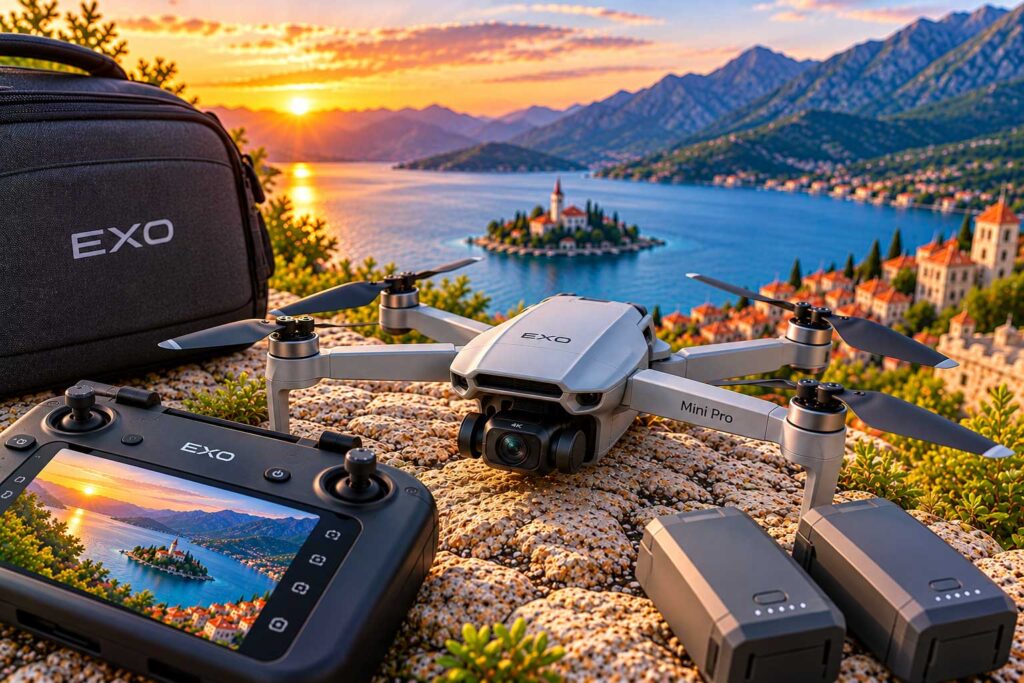
13. EXO Mini Pro – Lightweight Alternative to DJI
The EXO Mini Pro is another option for travelers looking beyond the better-known DJI lineup. Its biggest appeal is straightforward: it combines a lightweight, foldable body with 4K video, GPS-assisted flight, and a three-axis gimbal in a package designed to be easy to travel with.
At around 249 grams, the Mini Pro doesn’t add much weight to a camera bag or backpack. That makes it practical for vacations, road trips, hiking, and other situations where carrying a larger drone isn’t particularly appealing.
The camera records 4K video, while a three-axis mechanical gimbal helps keep footage stable during flight. GPS-assisted positioning and Return to Home provide the basic navigation features most travelers expect from a modern camera drone.
Depending on the version and package, the Mini Pro has also been offered with intelligent flight features designed to simplify tracking and automated filming.
The bigger question in 2026 is availability and value. The EXO Mini Pro has been on the market for several years, and newer lightweight drones now compete in the same space. Pricing, bundles, accessories, and availability can vary, so it’s worth comparing the exact package you’re considering against newer alternatives before buying.
Why It Stands Out
- Approximately 249 g
- Compact foldable design
- 4K video recording
- Three-axis mechanical gimbal
- GPS-assisted positioning
- Return to Home
- Intelligent flight features
- Alternative to the more common DJI travel drones
Pros and Cons
| Pros | Cons |
|---|---|
| ✓ Lightweight and easy to pack | ✗ Older model compared with several newer travel drones |
| ✓ Records 4K video | ✗ Availability and package contents can vary |
| ✓ Three-axis mechanical gimbal | ✗ Smaller accessory ecosystem than DJI |
| ✓ GPS-assisted positioning | ✗ Camera system is less sophisticated than current premium models |
| ✓ Return to Home functionality | ✗ Worth comparing carefully with newer sub-250 g competitors |
| ✓ Foldable design | |
| ✓ Suitable for casual travel photography |
EXO Mini Pro Specifications
| Feature | Details |
|---|---|
| Video | Up to 4K |
| Weight | Approx. 249 g |
| Gimbal | 3-axis mechanical |
| Positioning | GPS-assisted |
| Return to Home | Yes |
| Intelligent Flight Features | Yes |
| Foldable | Yes |
Specifications, battery configurations, included accessories, and available features can vary by version and package. Check the current product listing before purchasing.
Best For
The EXO Mini Pro may suit:
- Travelers looking for a DJI alternative
- Casual aerial photographers
- Road trips
- Weekend vacations
- Hiking trips
- First-time camera-drone buyers
- Travelers who prioritize a lightweight, foldable design
- Buyers who find it available at a competitive price
Bottom Line
The EXO Mini Pro offers many of the fundamentals travelers look for in a compact camera drone: 4K video, a three-axis gimbal, GPS-assisted positioning, Return to Home, and a lightweight foldable body.
Its biggest challenge in 2026 is competition. There are now several newer sub-250 g drones with increasingly sophisticated cameras, tracking systems, and safety features.
That doesn’t automatically rule out the EXO Mini Pro. If you find the right configuration at a good price, it can still be a practical option for casual travel photography. Just compare the exact model and package with newer alternatives before deciding.
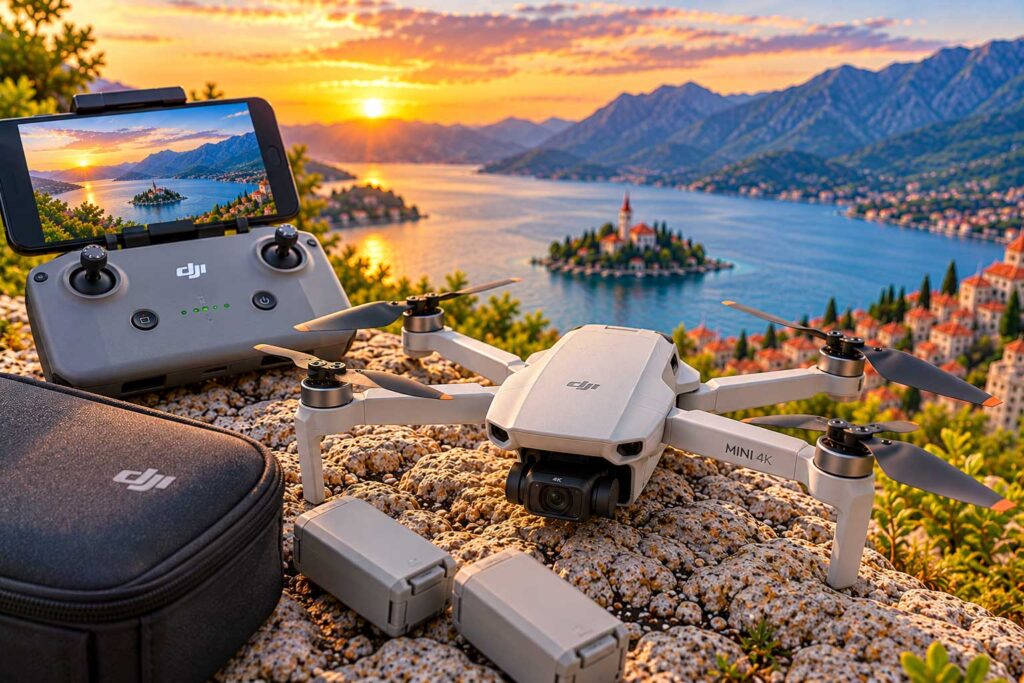
14. DJI Mini 4K – Best Travel Drone for Complete Beginners
The DJI Mini 4K is a much more capable starting point than the inexpensive toy-style drones many beginners encounter first. It gives new pilots the basic features of a proper camera drone while keeping the aircraft compact, lightweight, and relatively straightforward to fly.
Weighing under 249 grams, the Mini 4K is easy to fit into a backpack or small camera bag. Its folding design makes it particularly convenient for vacations, road trips, hiking, and other situations where you don’t want a large drone taking up valuable luggage space.
The camera records 4K video and, importantly, sits on a three-axis mechanical gimbal. That physical stabilization helps produce smoother footage than the electronic-only stabilization commonly found on inexpensive beginner drones.
For someone learning to fly, GPS-assisted positioning is another major advantage. The drone can maintain a stable hover without requiring constant corrections from the pilot, while Return to Home provides an additional safeguard if the battery becomes low or the connection is interrupted.
The Mini 4K doesn’t offer the sophisticated obstacle-sensing technology found on DJI’s more expensive models, so beginners still need to pay close attention to trees, buildings, power lines, and other obstacles.
Why It Stands Out
- Weighs under 249 g
- Records up to 4K video
- Three-axis mechanical gimbal
- GPS-assisted positioning
- Return to Home
- Foldable travel-friendly design
- Stable hovering
- Straightforward controls for beginners
- More capable than most inexpensive toy drones
Pros and Cons
| Pros | Cons |
|---|---|
| ✓ Lightweight and easy to travel with | ✗ No comprehensive obstacle-sensing system |
| ✓ 4K video recording | ✗ Camera is less advanced than newer premium Mini models |
| ✓ Three-axis mechanical gimbal | ✗ Beginners still need to actively watch for obstacles |
| ✓ GPS-assisted hovering | ✗ Fewer advanced tracking features than higher-end DJI drones |
| ✓ Return to Home | |
| ✓ Compact folding design | |
| ✓ Good stepping stone into camera-drone photography |
DJI Mini 4K Specifications
| Feature | Details |
|---|---|
| Video | Up to 4K/30fps |
| Weight | Under 249 g |
| Gimbal | 3-axis mechanical |
| Positioning | GNSS/GPS-assisted |
| Return to Home | Yes |
| Foldable | Yes |
Flight time and performance vary with wind, temperature, flight speed, battery condition, and other operating conditions.
Best For
The DJI Mini 4K is particularly well suited to:
- First-time camera-drone owners
- Beginner pilots
- Family vacations
- Road trips
- Hiking and camping
- Casual aerial photography
- Travelers learning drone videography
- Buyers moving beyond inexpensive toy drones
Bottom Line
The DJI Mini 4K is a sensible starting point for someone who wants to learn aerial photography rather than simply fly a toy drone around the backyard.
Its combination of 4K video, a three-axis gimbal, GPS-assisted positioning, Return to Home, and a sub-249 g folding body covers most of the fundamentals a beginner needs.
It lacks the advanced obstacle sensing and camera technology of more expensive models such as the Mini 4 Pro, but that’s also part of what keeps the Mini 4K simpler and more affordable.
For travelers buying their first proper camera drone, it provides plenty of room to learn before there’s a real need to upgrade.
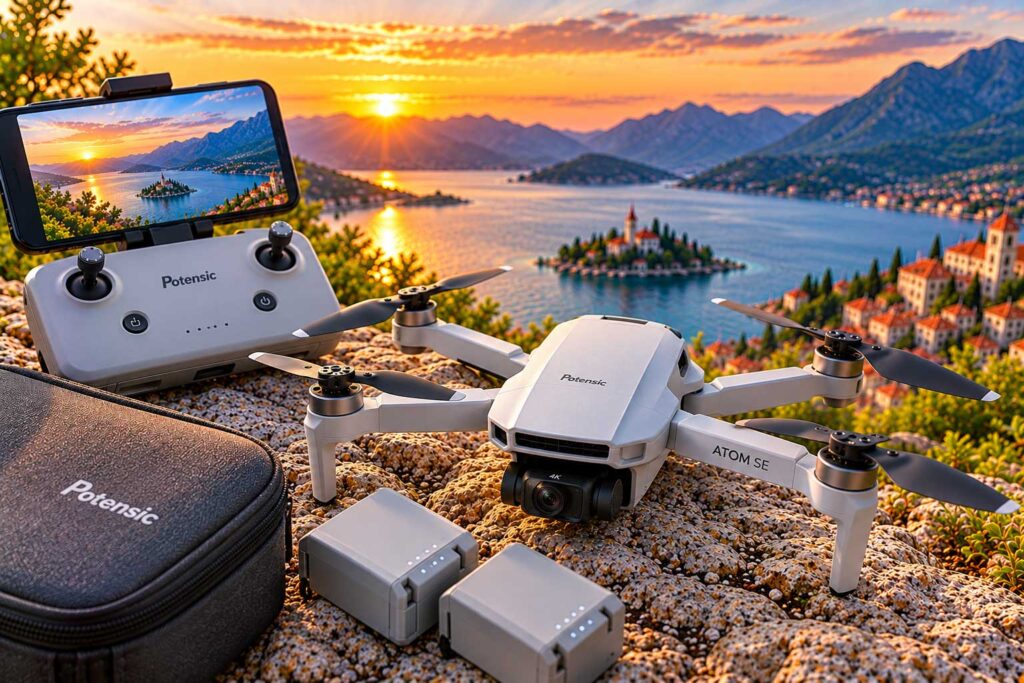
15. Potensic ATOM SE – Best Entry-Level Travel Drone
The Potensic ATOM SE finishes our list as a straightforward option for travelers who want to try aerial photography without spending heavily on their first drone.
Weighing under 249 grams, it’s compact enough to carry in a backpack or camera bag and folds down for easier storage. That makes it convenient for road trips, camping, hiking, family vacations, and other trips where you don’t want drone equipment taking up much space.
The ATOM SE records 4K video and uses Potensic’s electronic stabilization system to help smooth footage. It doesn’t have the three-axis mechanical gimbal found on the newer ATOM 2, so travelers who care more about video stabilization should consider stepping up to that model.
GPS-assisted positioning is another useful feature for beginners. It helps the drone maintain its position during flight and supports Return to Home, giving new pilots some of the navigation features expected from a proper camera drone rather than a basic toy model.
There are obvious compromises at this price level. The ATOM SE doesn’t include a comprehensive obstacle-sensing system, and its camera and stabilization system are less sophisticated than those found on newer models.
But if your priorities are low weight, GPS, 4K recording, and an accessible price, the ATOM SE still covers the fundamentals.
Why It Stands Out
- Weighs under 249 g
- Records up to 4K video
- GPS-assisted positioning
- Return to Home
- Electronic image stabilization
- Foldable travel-friendly design
- Straightforward controls
- Lower-cost entry into GPS camera drones
Pros and Cons
| Pros | Cons |
|---|---|
| ✓ Lightweight at under 249 g | ✗ No comprehensive obstacle-sensing system |
| ✓ 4K video recording | ✗ Electronic stabilization rather than a 3-axis mechanical gimbal |
| ✓ GPS-assisted positioning | ✗ Camera system is less advanced than newer models |
| ✓ Return to Home | ✗ Fewer advanced tracking and filming features |
| ✓ Compact folding design | ✗ ATOM 2 is the stronger choice if your budget allows |
| ✓ Accessible option for first-time buyers | |
| ✓ Easy to carry on trips |
Potensic ATOM SE Specifications
| Feature | Details |
|---|---|
| Video | Up to 4K |
| Weight | Under 249 g |
| Stabilization | Electronic stabilization |
| Positioning | GPS/GNSS-assisted |
| Return to Home | Yes |
| Foldable | Yes |
Flight time and performance vary with wind, temperature, flight speed, battery condition, and other operating conditions. Check the current manufacturer’s specifications for the package you’re considering.
Best For
The Potensic ATOM SE is particularly well suited to:
- First-time drone buyers
- Budget-conscious travelers
- Family vacations
- Weekend road trips
- Camping
- Hiking
- Casual aerial photography
- Beginners who want GPS and Return to Home
Bottom Line
The Potensic ATOM SE makes the most sense for travelers who want the basic capabilities of a GPS camera drone while keeping the purchase price relatively low.
You get 4K recording, GPS-assisted positioning, Return to Home, a folding body, and a weight under 249 grams, but you give up the mechanical gimbal and more advanced features available on newer drones.
If the price difference is small, the Potensic ATOM 2 is the model we’d compare first because of its three-axis gimbal and newer camera system. But when the ATOM SE is significantly cheaper, it remains a practical entry point for casual travel photography.
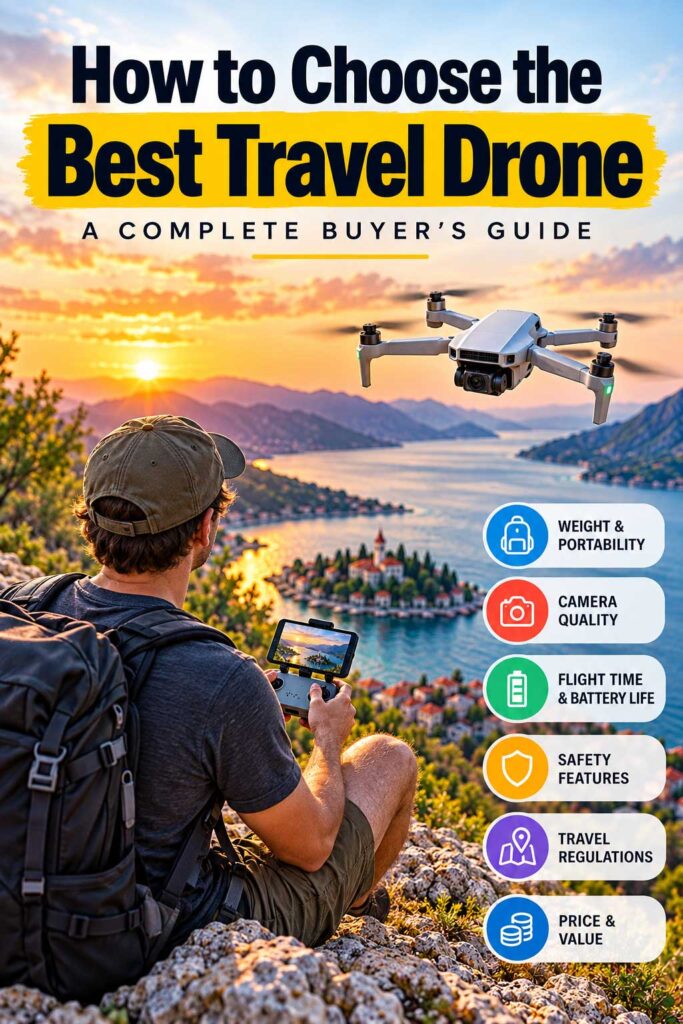
How to Choose the Best Travel Drone
Choosing a travel drone isn’t simply a matter of buying the model with the longest specification sheet. The right choice depends on how you travel, what you want to photograph, how much equipment you’re willing to carry, and how much you want to spend.
A backpacker walking several miles each day may care more about weight than having the largest camera sensor. Someone planning a photography-focused road trip may happily carry a heavier drone in exchange for better image quality. A first-time pilot may benefit more from straightforward controls and reliable safety features than professional video settings they’ll rarely use.
There are practical considerations too. Battery restrictions can affect air travel, drone regulations vary between countries, and the lightest drone isn’t automatically exempt from local flight rules.
Before buying, compare the factors that will actually affect how you use the drone: weight and portability, camera quality, stabilization, flight time, safety features, ease of use, battery options, and local regulations.
1. Weight and Portability
For travel, weight matters more than it might seem when you’re shopping from home.
A drone may look compact on a product page, but remember that you’ll probably also carry a controller, spare batteries, charger, cables, propellers, filters, and a protective case.
For backpacking, hiking, and trips involving frequent flights or train travel, a sub-250 g folding drone can be especially convenient. Models such as the DJI Mini series and several Potensic and Autel alternatives take up relatively little room and can fit into bags you’re already carrying.
Larger drones make more sense when image quality, flight performance, or camera versatility matters more than keeping your luggage light.
Don’t choose based on aircraft weight alone. Think about the entire kit you’ll actually carry.
2. Camera Quality and Sensor Size
If photography and video are the main reasons you’re buying a drone, look beyond the resolution printed on the box.
Two drones can both record 4K video and still produce noticeably different results.
Important camera specifications include:
- Sensor size
- Lens aperture
- Dynamic range
- Photo resolution
- Available video frame rates
- HDR capabilities
- RAW photo support
- Manual camera controls
- Low-light performance
Larger sensors generally have advantages when you’re photographing scenes with difficult lighting, such as sunsets, mountains, coastlines, and cities around sunrise or dusk.
For casual vacation footage, however, you may not need the largest sensor available. A smaller modern camera combined with good stabilization can produce excellent travel footage while keeping the drone considerably lighter.
3. Video Stabilization
Stabilization is particularly important for aerial video.
A three-axis mechanical gimbal physically stabilizes the camera as the drone moves, helping footage remain smooth when the aircraft turns, accelerates, or encounters light wind.
Some smaller drones rely more heavily on electronic image stabilization. This can work well for casual clips and self-filming, but it isn’t the same system used by most dedicated camera drones.
If smooth cinematic footage is one of your priorities, a three-axis gimbal deserves serious consideration.
4. Flight Time and Battery Life
Manufacturer flight-time figures are useful for comparing drones, but don’t expect to spend every advertised minute filming.
Maximum flight times are generally measured under controlled test conditions. Real-world battery life can be affected by:
- Wind
- Temperature
- Altitude
- Flight speed
- Camera use
- Battery age and condition
- Repeated takeoffs and landings
- The amount of battery reserve you leave before landing
A drone advertised with 30 or 40 minutes of flight time won’t necessarily provide that much usable shooting time on every flight.
For travel, extra batteries can be just as important as maximum flight time. Three shorter batteries may be more useful during a full day of exploring than one battery with a slightly better specification.
5. Obstacle Sensing and Safety Features
Obstacle sensing can be extremely useful, especially if you’re still learning to fly.
More advanced drones may use cameras and sensors to detect obstacles in several directions. Depending on the model and flight mode, these systems can help the aircraft brake, avoid certain obstacles, or navigate around them.
Less expensive drones may have only downward positioning sensors—or no meaningful obstacle detection at all.
Useful safety and flight features can include:
- Forward obstacle sensing
- Backward obstacle sensing
- Side obstacle sensing
- Upward and downward sensing
- Return to Home
- Low-battery warnings
- Automatic landing functions
- Geofencing or airspace information
No obstacle-sensing system should be treated as permission to fly carelessly. Thin branches, wires, reflective surfaces, low light, and other conditions can still cause problems.
Think of obstacle sensing as another layer of protection, not an invisible shield around the drone.
6. GPS, Return to Home, and Tracking
For a conventional travel camera drone, reliable positioning can make flying much easier.
GPS/GNSS-equipped drones can use satellite positioning to maintain their location and support features such as Return to Home.
Return to Home can be particularly useful if the battery becomes low or the connection between the controller and aircraft is interrupted. However, pilots should understand how the feature works on their particular drone and configure appropriate settings before relying on it.
Some drones also include intelligent subject-tracking modes that can follow a person, vehicle, or other subject automatically.
These features can be useful for hiking, cycling, road trips, and solo travel, but tracking capabilities vary considerably between models.
7. Wind Resistance and Flight Performance
Travel rarely gives you perfect flying conditions.
Coastlines, mountains, islands, and exposed viewpoints—the places where you may most want to fly—can also be windy.
Larger and more powerful drones will often have advantages in demanding conditions, while very small aircraft may need more caution.
Don’t judge wind performance only by the drone’s weight. Motor power, aircraft design, flight software, and the manufacturer’s specified operating limits also matter.
And remember that getting away from the launch point is only half the flight. A drone traveling quickly with a tailwind may face a much harder return journey against that same wind.
8. Ease of Use
Your experience level should influence your choice.
For a first drone, useful features may include:
- Stable hovering
- Straightforward controls
- Automatic takeoff and landing
- Return to Home
- Beginner flight modes
- Clear battery warnings
- Automated filming modes
Advanced camera controls and professional video formats are valuable if you know how to use them, but they shouldn’t automatically outweigh simplicity for a new pilot.
A drone you’re comfortable flying will probably capture more useful footage than a more sophisticated model you’re nervous about taking out of its case.
9. Think About Where You’ll Be Traveling
The same drone isn’t ideal for every type of trip.
For backpacking and hiking, prioritize low weight, compact dimensions, and battery efficiency.
For beach and island trips, portability still matters, but wind performance becomes more important.
For road trips, you have more freedom to carry a larger drone, additional batteries, charging equipment, and a protective case.
For photography-focused trips, camera quality, RAW photography, sensor size, manual controls, and multiple focal lengths may justify carrying additional weight.
For solo travel and action footage, automated tracking and hands-free filming features may matter more than traditional aerial photography specifications.
Start with the way you actually travel, then choose the drone—not the other way around.
10. Consider Regulations Before Choosing a Drone
Weight can affect how a drone is regulated, which is one reason sub-250 g models are so popular with travelers.
But under 250 grams does not mean unrestricted flying.
Registration, remote identification, pilot competency, airspace, privacy, operating-category, and location-specific requirements can still apply depending on the country and type of flight.
If you plan to travel internationally, researching the regulations of the countries you visit should be part of choosing the drone itself.
A slightly smaller aircraft may simplify certain requirements in some jurisdictions, but it doesn’t remove your responsibility to understand the local rules.
11. Don’t Forget the Controller and Phone
The drone isn’t the only piece of equipment you’ll use.
Some controllers require a smartphone, while others include a built-in screen. A controller with its own display can be convenient because you don’t need to connect your phone every time you fly.
On the other hand, smartphone-based controllers can cost less and may be perfectly adequate for occasional use.
Also consider:
- Controller size and weight
- Screen brightness
- Battery life
- Charging connection
- Phone compatibility
- Whether an internet connection is required for particular functions
These details may seem minor at home but become much more noticeable when you’re traveling.
12. Set a Realistic Budget
Don’t spend your entire budget on the aircraft itself.
Your actual setup may also require:
- Extra batteries
- A charging hub
- Memory cards
- Spare propellers
- ND filters
- A carrying case
- Additional charging equipment
A cheaper drone that leaves room in your budget for two extra batteries and a good case may be more useful on a trip than a more expensive aircraft you can only fly once before needing to recharge.
The goal isn’t to buy the most expensive drone you can afford. It’s to build a travel setup you’ll actually want to carry and use.
Which Travel Drone Is Right for You?
If portability is your biggest priority, start with the sub-250 g models. If you’re buying your first proper camera drone, prioritize straightforward controls, stable positioning, and Return to Home. Travelers focused primarily on photography and filmmaking may benefit from a larger sensor, better obstacle sensing, longer flight time, and more advanced camera controls.
And if your goal is primarily to film yourself hiking, cycling, or exploring, a compact self-flying camera may make more sense than a conventional camera drone.
There isn’t one travel drone that’s right for everyone.
The best choice is the one that gives you the camera quality and flight features you genuinely need without becoming equipment you don’t want to carry.
Essential Travel Drone Accessories
You don’t need to fill your backpack with drone accessories, but a few carefully chosen extras can make a noticeable difference when you’re traveling.
You can also find more useful electronics and accessories in our guide to the Best Travel Gadgets for Smarter Adventures.
The most useful accessories either extend your flying time, protect expensive equipment, or solve problems that are difficult to fix once you’re away from home. What you actually need will depend on your drone and the type of trip you’re taking.
Extra Batteries
For many travelers, extra batteries are the first accessory worth buying.
Manufacturer-rated flight times don’t represent the amount of usable filming time you’ll necessarily get from every battery. Wind, temperature, flight speed, repeated takeoffs, and the need to land with a reasonable battery reserve can all shorten a session.
Carrying two or three batteries can make a big difference on a full day of sightseeing or hiking.
Remember that spare lithium batteries also need to be transported according to airline rules when you’re flying.
Multi-Battery Charging Hub
If your drone supports one, a charging hub can simplify overnight charging when you’re traveling with several batteries.
Be aware that many drone charging hubs don’t charge every battery simultaneously. Some charge batteries sequentially, often prioritizing the battery with the highest remaining charge.
Even so, being able to connect several batteries and leave the hub to manage them can be much more convenient than swapping batteries manually throughout the evening.
High-Speed microSD Cards
High-resolution drone video can consume storage surprisingly quickly.
Before buying a card, check the manufacturer’s recommended capacity and speed specifications for your particular drone. A card that works perfectly in a phone or basic camera isn’t necessarily fast enough for high-bitrate 4K or 5.1K recording.
It’s also worth carrying a second card. A tiny spare takes almost no luggage space and can save the day if your primary card becomes full, damaged, or corrupted.
Protective Carrying Case
Travel can be harder on a drone than flying it.
Airport security trays, tightly packed luggage, rental cars, hiking backpacks, and repeated hotel changes all create opportunities for equipment to get knocked around.
A padded case works well for most trips, while a hard-shell case provides additional protection when your equipment is likely to receive rougher treatment.
At minimum, make sure the drone, gimbal, controller, batteries, and propellers are protected rather than moving freely inside your luggage.
Portable Landing Pad
A landing pad isn’t essential everywhere, but it becomes surprisingly useful on beaches, trails, campsites, and other uneven surfaces.
It creates a cleaner area for takeoff and landing when the ground is covered with:
- Sand
- Dust
- Gravel
- Tall grass
- Mud
- Snow
Keeping loose debris away from the motors, propellers, and camera is reason enough to consider packing one if you regularly fly away from paved surfaces.
ND Filters
Neutral-density filters reduce the amount of light reaching the camera.
For video creators, that can make it easier to use slower shutter speeds in bright conditions and maintain more natural-looking motion blur.
They’re particularly useful when filming in intense sunlight around beaches, lakes, mountains, islands, and snow-covered landscapes.
Make sure you buy filters designed specifically for your drone’s camera.
Spare Propellers
Propellers are lightweight, inexpensive, and extremely difficult to replace when you’re halfway through a trip.
A minor landing accident or contact with a branch can damage one enough that it shouldn’t be used again.
Carry at least one compatible spare set along with the correct screws and installation tool if your drone requires them.
Never continue flying with a cracked, bent, chipped, or otherwise damaged propeller.
Portable Power Bank
A USB-C power bank can be useful for charging phones, controllers, and other electronics while you’re away from an outlet.
Some drone charging systems can also work with compatible USB-C power sources, but don’t assume every power bank can charge every drone battery. Check the required charging protocol and power output for your particular drone and charger.
For hiking and camping trips, a compatible high-output power bank can be especially useful.
Lens Cleaning Kit
A fingerprint or small water spot can ruin otherwise beautiful footage.
A microfiber cloth and appropriate lens-cleaning supplies take almost no space and make it easy to clean the camera before takeoff.
Check the lens before every important flight, particularly after flying near beaches, waterfalls, dusty roads, or humid environments.
Drone Backpack or Camera Bag
You probably don’t need a dedicated drone backpack if you’re traveling with a tiny model and one spare battery.
But once you’re carrying a larger drone, controller, several batteries, charger, filters, spare propellers, and possibly a conventional camera, good organization becomes much more important.
Choose a bag with enough padding and adjustable compartments to prevent the equipment from moving around while you’re walking.
The best bag isn’t necessarily the largest one—it’s the one that protects everything you actually use without encouraging you to carry unnecessary gear.
Drone Laws and Travel Tips Before You Fly
Buying the right drone is only part of preparing for a trip. You also need to know where you’re allowed to fly, whether registration is required, how to transport your batteries, and what restrictions apply at your destination.
Drone rules can change significantly when you cross a border. A flight that’s perfectly legal in one country may require registration, authorization, or additional documentation somewhere else. Even within the same country, airports, national parks, military areas, historic sites, and protected natural areas can have their own restrictions.
Before traveling with a drone, check the rules for both your destination and the type of flying you plan to do.
Check Local Drone Regulations
Don’t assume that a lightweight drone can be flown anywhere simply because it weighs less than 250 grams.
Depending on the country and type of operation, you may need to check:
- Drone registration requirements
- Pilot registration or certification
- Maximum permitted altitude
- Visual-line-of-sight requirements
- Controlled and restricted airspace
- Rules for flying near airports
- Restrictions around people and crowds
- Privacy regulations
- Rules for protected areas and historic sites
- Requirements for recreational versus non-recreational operations
For example, in the United States, recreational pilots generally must register drones weighing 250 grams or more, while drones below that weight can qualify for an exemption from registration when flown strictly under the recreational exception. Other requirements can still apply, however, and registered drones are generally subject to Remote ID requirements.
Travelers flying in the United States can check current requirements directly through the FAA’s official drone registration guidance.
When traveling internationally, start with the country’s official civil aviation authority rather than relying entirely on blogs, social media posts, or old forum discussions.
For trips within Europe, the European Union Aviation Safety Agency (EASA) provides guidance on EU drone rules and operating categories.
Understand Airline Battery Rules
Drone batteries require a little extra planning when you’re flying.
In the United States, the FAA requires spare lithium-ion batteries to remain in carry-on baggage rather than checked luggage. Spare batteries also need to be protected against damage and short circuits.
Before packing your batteries, review the FAA PackSafe guidance for airline passengers and batteries and then check your airline’s own requirements.
For lithium-ion batteries, the FAA currently allows batteries rated at 100 Wh or less on passenger aircraft under its standard limits. Batteries from 101–160 Wh generally require airline approval, while batteries above 160 Wh aren’t permitted on passenger aircraft under the normal passenger-baggage rules. Airlines can impose additional restrictions.
Before leaving for the airport:
- Check the watt-hour rating printed on each battery
- Keep spare batteries in your carry-on
- Protect exposed battery terminals from short circuits
- Consider individual battery sleeves or protective cases
- Don’t travel with damaged or swollen batteries
- Check your airline’s specific battery policy
- Recheck the rules when flying internationally
If your carry-on bag is unexpectedly gate-checked, remove your spare lithium batteries before handing over the bag.
Check Restricted and No-Fly Areas
Being legally allowed to bring a drone into a country doesn’t mean you can fly it everywhere once you arrive.
Restrictions are commonly found around:
- Airports and airfields
- Military installations
- Government facilities
- Protected natural areas
- Wildlife habitats
- Certain national parks
- Historic and archaeological sites
- Large public gatherings
- Temporary security zones
Don’t rely exclusively on the map inside your drone’s app. Manufacturer geofencing can be useful, but it isn’t a substitute for checking the official aviation authority and any rules imposed by the site or land manager.
In the United States, for example, recreational pilots need authorization before operating in controlled airspace and generally must remain at or below 400 feet in uncontrolled Class G airspace.
If you’re flying in the United States, the FAA’s recreational flyer guidance explains current airspace, altitude, authorization, and safety requirements.
Respect People, Property, and Wildlife
Legal doesn’t always mean considerate.
Avoid flying unnecessarily close to homes, hotel balconies, crowded beaches, wildlife, or people who clearly don’t want to be filmed. Some destinations also have specific privacy, wildlife, or property-access rules that apply in addition to aviation regulations.
Wildlife deserves particular attention. A drone approaching an animal may disturb it long before the pilot realizes there’s a problem.
Keeping a reasonable distance also makes travel drone photography less intrusive for everyone sharing the destination.
Consider Drone and Travel Insurance
A drone can represent a substantial amount of money once you include batteries, controllers, filters, memory cards, and other accessories.
Before traveling, check whether your existing travel, homeowners, renters, or equipment insurance covers your drone away from home.
Depending on your trip and how you use the drone, you may want coverage for:
- Accidental damage
- Theft
- Loss while traveling
- Equipment carried internationally
- Third-party liability
Professional photographers and commercial operators may have different insurance needs, particularly when the drone is being used for paid work.
Read the policy carefully rather than assuming that ordinary travel insurance automatically covers drone equipment or liability.
Use a Pre-Flight Checklist
Even experienced pilots can forget something when they’re rushing to capture a sunset or trying to launch before the weather changes.
Before takeoff, check:
- Battery charge
- Propellers for cracks or damage
- Current weather and wind conditions
- Local flight restrictions
- Airspace restrictions
- Available storage on your memory card
- Aircraft and controller connection
- Home point and Return-to-Home settings, when applicable
- GPS/GNSS status on drones that use satellite positioning
- Camera settings
- Surrounding trees, wires, buildings, people, and other obstacles
- Whether firmware or app updates are needed before leaving your accommodation
You don’t necessarily need to recalibrate the compass before every flight. Follow the manufacturer’s instructions and any warning displayed by the aircraft rather than making unnecessary calibration part of your automatic routine.
A two-minute check before takeoff can prevent a ruined flight—or a much more expensive mistake.
One Final Rule: Check Again Before You Fly
Drone regulations, temporary flight restrictions, local site rules, and airline policies can change.
Research the general requirements while planning your trip, but check them again shortly before departure and before flying at a new location.
Your drone manufacturer’s app can help with flight planning, but official aviation authorities and local authorities should be your primary sources for current rules.
A little preparation makes traveling with a drone much easier—and lets you spend more time concentrating on the reason you brought it in the first place: capturing the trip from a perspective you couldn’t get from the ground.
Common Mistakes to Avoid When Traveling With a Drone
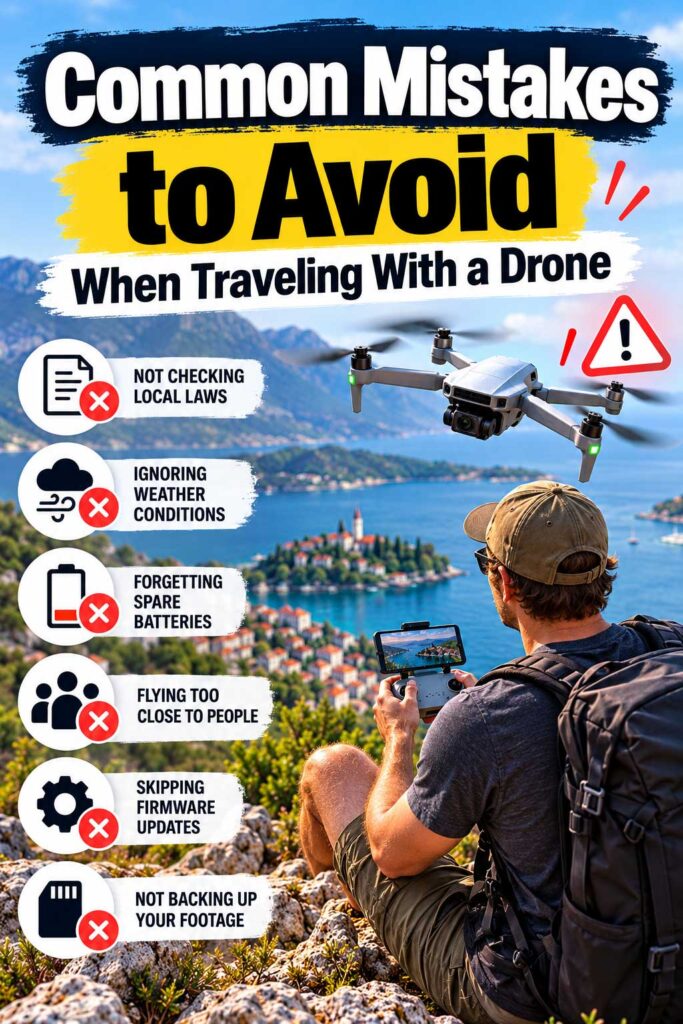
Travel creates situations you don’t encounter when flying close to home. You’re dealing with unfamiliar airspace, changing weather, new regulations, limited charging opportunities, and locations you may only get one chance to photograph.
Avoiding a few common mistakes can make the difference between coming home with great footage and leaving an expensive drone in your backpack—or worse, losing it entirely.
Flying Before Checking the Local Rules
Don’t arrive at a viewpoint, see an incredible landscape, and immediately launch.
Check the local aviation rules, airspace restrictions, property rules, and any restrictions that apply to the specific attraction or protected area.
A location being beautiful doesn’t mean drone flights are permitted there.
Ignoring Wind and Weather
Weather at ground level doesn’t always tell you what conditions will be like higher in the air.
Wind can reduce battery life, make returning to the takeoff point more difficult, and push a lightweight drone farther than expected.
Rain, fog, extreme heat, and cold temperatures can create additional problems depending on the aircraft.
Check the forecast and your drone manufacturer’s operating limits before flying.
Using Every Last Percent of the Battery
A manufacturer’s maximum flight-time figure shouldn’t become your target for every flight.
Leave enough battery to return and land safely, especially when flying over water, mountains, forests, or locations where recovering the drone would be difficult.
Flying farther away because “there are still ten minutes left” can become a problem quickly if you’re returning against the wind.
Flying Too Close to People or Wildlife
A dramatic shot isn’t worth creating an unnecessary risk or disturbing other people.
Keep appropriate distances from people, crowds, vehicles, buildings, and wildlife, and follow the rules that apply to your location and type of flight.
Wildlife can be particularly sensitive to drones, so don’t chase animals or repeatedly approach them for a better shot.
Updating Everything at the Last Minute
Keeping firmware and apps current can be important, but the airport, trailhead, or five minutes before sunrise isn’t the ideal place to discover that an update changed a setting or requires another download.
Check for necessary updates before your trip—or at least well before an important flight—and give yourself enough time to confirm that the aircraft, controller, batteries, and app are working properly afterward.
Taking Off Before Positioning Is Ready
For drones that use GPS/GNSS positioning, give the aircraft time to establish the positioning information it needs and confirm that the home point has been recorded correctly before relying on features such as Return to Home.
Not every drone uses GPS in the same way, so follow the instructions for your specific model rather than applying the same launch routine to every aircraft.
Setting Return to Home Incorrectly
Return to Home can be extremely useful, but it isn’t magic.
Before flying, understand how your drone’s RTH system works and check the relevant settings. Where the aircraft allows you to configure an RTH altitude, consider surrounding trees, buildings, terrain, and other obstacles.
The correct setting depends on the environment you’re flying in.
Forgetting to Check the Propellers
Propellers are easy to overlook because damage can be small.
Before takeoff, look for cracks, chips, deformation, loose hardware, or anything else that doesn’t look normal.
If you’re unsure about a damaged propeller, replacing it is far cheaper than replacing the drone.
Leaving the Memory Card at the Hotel
It sounds ridiculous until it happens.
Before hiking an hour to a viewpoint, confirm that your memory card is installed, has enough available space, and is recognized by the drone.
Keeping a spare card in your drone case is an easy backup.
Not Backing Up Your Footage
Travel footage can be difficult—or impossible—to recreate.
When practical, copy important photos and videos to a laptop, portable SSD, or another backup location at the end of the day.
For an especially important trip, keeping two copies in separate places provides additional protection if a device is lost, stolen, or damaged.
A few minutes spent checking your equipment, weather, airspace, battery level, and storage before each flight can prevent many of the problems travelers encounter with drones.
More importantly, good preparation lets you concentrate on the scenery and the footage rather than worrying about something you forgot.
Frequently Asked Questions About Best Travel Drones
What is a good all-around travel drone in 2026?
The DJI Mini 4 Pro is a strong all-around option for travelers who want a compact drone without giving up many advanced features. It weighs under 249 grams with the standard battery and combines 4K video, a three-axis gimbal, omnidirectional obstacle sensing, and intelligent tracking features.
Travelers who care more about camera performance than minimum weight may prefer a larger model such as the DJI Air 3S.
Which travel drone is best for beginners?
Several drones in this guide work well for beginners, but they suit slightly different users.
The DJI Mini 4K is a straightforward introduction to a conventional GPS camera drone, while the DJI Flip adds additional automated shooting features and integrated propeller guards. The DJI Neo is particularly appealing if your priority is quick, automated self-filming rather than traditional aerial photography.
The Potensic ATOM 2 is another option worth comparing if you want a lightweight alternative to DJI.
Can I bring a drone on an airplane?
Generally, yes, but you need to pay particular attention to the batteries.
In the United States, spare lithium batteries must be carried in your carry-on baggage rather than checked baggage and protected against short circuits. Battery capacity limits also apply, and individual airlines may impose additional requirements.
Rules can differ internationally, so check both aviation-security requirements and your airline’s current battery policy before traveling.
Do I need to register my travel drone?
That depends on the country, the weight of the drone, and how you’re using it.
Some jurisdictions treat drones below 250 grams differently from heavier aircraft, but being below that threshold doesn’t automatically exempt you from every drone rule.
Registration, pilot competency, Remote ID, airspace, privacy, and operating restrictions may still apply depending on your location and type of flight.
Always check the official aviation authority for your destination before flying.
Which drone has the strongest camera system in this guide?
For travelers prioritizing camera versatility, the DJI Mavic 3 Pro stands out because of its triple-camera system, including a 4/3 CMOS Hasselblad main camera and additional telephoto options.
The DJI Air 3S provides another compelling option with its dual-camera system while being smaller and lighter than the Mavic 3 Pro.
For many travelers, however, the additional portability of a smaller drone may be more valuable than carrying the most advanced camera system.
How long do travel drone batteries last?
The drones in this guide vary considerably, with manufacturer-rated maximum flight times ranging from relatively short sessions on ultra-compact self-flying cameras to more than 40 minutes on some larger camera drones.
Actual flying time can be shorter because of:
- Wind
- Temperature
- Flight speed
- Altitude
- Battery condition
- Flight maneuvers
- The battery reserve needed for a safe return and landing
Treat advertised flight times as a useful comparison point rather than a guarantee of how long every flight will last.
Is a drone under 249 grams better for travel?
It can be.
Sub-250 g drones are popular with travelers because they’re easier to carry and may fall into different regulatory categories in some countries.
They’re especially convenient for backpacking, hiking, city breaks, and trips where luggage space is limited.
But weight shouldn’t be your only consideration. Larger drones can offer advantages in camera performance, flight capability, battery life, and other areas.
And remember: under 249 grams does not mean you can fly anywhere you want.
Can beginners learn to fly a travel drone?
Yes. Many modern camera drones include features that can make learning considerably easier, such as stable hovering, automated takeoff and landing, Return to Home, beginner-friendly flight modes, and automated filming options.
Some models also include obstacle-sensing systems.
These features reduce the workload for a new pilot, but they don’t replace learning the controls, understanding local regulations, checking the surroundings, and practicing in an appropriate open area before attempting more complicated flights.
Are travel drones waterproof?
Most consumer travel drones should not be treated as waterproof.
Unless the manufacturer specifically states that your aircraft is designed for wet conditions, avoid flying in rain or exposing it unnecessarily to water.
Fog, sea spray, waterfalls, and snow can also introduce moisture, so check the manufacturer’s operating guidance before flying in questionable weather.
What accessories are most useful for a travel drone?
You don’t necessarily need every accessory available for your drone.
For most travelers, the most useful additions are extra batteries, compatible high-speed microSD cards, spare propellers, and a protective case or bag.
Depending on your drone and the type of trip, you may also benefit from:
- A compatible charging hub
- ND filters
- A portable landing pad
- A compatible USB-C power bank
- Lens-cleaning supplies
- A larger camera or drone backpack
Start with the equipment you’ll actually use rather than turning a lightweight drone into a backpack full of accessories.
Related Travel Gear Guides
Planning another trip? These Discover Balkania guides can help you choose useful gear, pack more efficiently, and prepare for your next adventure.
- Best Travel Gadgets for Smarter Adventures – Discover useful travel gadgets for staying organized, connected, and comfortable on the road.
- Travel Gear for the Balkans – Plan what to pack for a Balkan trip, from practical luggage and clothing to electronics and everyday travel essentials.
Whether you’re bringing a camera drone on a Balkan road trip or simply trying to pack lighter for a weekend away, choosing practical gear before you leave can make the journey considerably easier.
Final Thoughts on Choosing the Best Travel Drone
A good travel drone should add something to your trip without becoming a burden every time you pack your bag.
For many travelers, that means choosing a compact model that’s easy to carry but still capable of producing footage worth bringing home. The DJI Mini 4 Pro strikes that balance particularly well, combining a sub-249 g design with a capable camera, three-axis gimbal, obstacle sensing, and intelligent flight features.
But it won’t be the right choice for everyone.
If photography and filmmaking are the priority and you don’t mind carrying more equipment, the DJI Air 3S or DJI Mavic 3 Pro provides more camera capability. Beginners have simpler options such as the DJI Mini 4K and DJI Flip, while travelers watching their budget can compare models such as the Potensic ATOM 2 and ATOM SE.
And sometimes the smallest option makes the most sense. If you mainly want clips of yourself walking, hiking, or cycling, an ultra-compact self-flying camera such as the DJI Neo or HOVERAir X1 PRO may fit your trip better than a traditional camera drone.
Think about the places you’re actually going to visit. A drone that’s perfect for a road trip isn’t necessarily what you’ll want in your backpack during a week of mountain hiking.
Whichever model you choose, spend some time learning how it works before your trip. Check the rules at your destination, understand the battery requirements if you’re flying, and don’t assume that a spectacular viewpoint automatically means drones are allowed there.
Then, when you finally reach that mountain pass, quiet coastline, island, or old town you’ve been waiting to photograph, you can concentrate on capturing the scene rather than figuring out your equipment.
That’s ultimately what the best travel drone should do: give you a perspective on the journey that you simply couldn’t capture from the ground.
What's your reaction?